
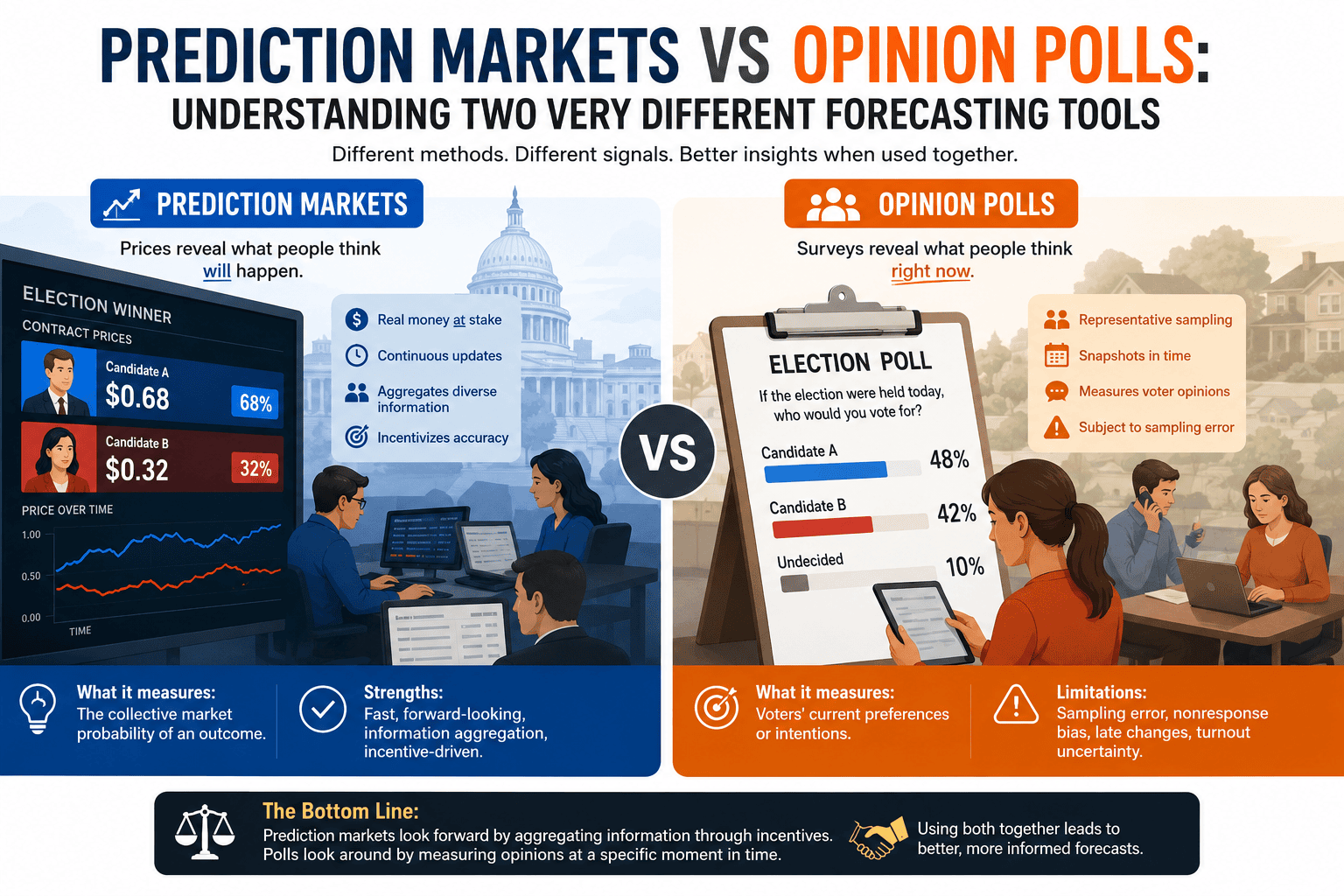
Election seasons are filled with polls, probability charts, expert commentary, and increasingly, prediction markets. While both prediction markets and opinion polls aim to provide insight into future election outcomes, they work in fundamentally different ways.
Opinion polls ask voters what they intend to do. Prediction markets ask participants what they believe will happen, often requiring them to put real or simulated money behind their expectations. These contrasting approaches mean that the two methods measure different aspects of political reality.
Understanding prediction markets vs polls requires recognizing that neither is designed to predict elections with perfect certainty. Instead, each provides a different lens through which uncertainty can be examined. Researchers, journalists, political scientists, and data analysts increasingly use both methods together because they offer complementary information rather than competing truths.
What Are Opinion Polls?
Opinion polls are structured surveys that collect responses from a sample of eligible voters. Pollsters attempt to estimate public opinion by asking questions about voting intentions, candidate preferences, issue priorities, or approval ratings.
Modern polling relies on statistical sampling. Since interviewing every voter is impractical, pollsters select a smaller group intended to represent the larger electorate.
A typical election poll involves:
- Selecting a representative sample
- Asking standardized questions
- Weighting responses to reflect population demographics
- Reporting estimated vote shares
- Publishing a margin of sampling error
Polls provide a snapshot of public opinion at a particular moment rather than a prediction of the final election result.
What Are Prediction Markets?
Prediction markets operate differently. Instead of surveying voters, they create markets where participants trade contracts tied to future events.
For example, a contract might pay $1 if Candidate A wins an election and $0 otherwise. If the contract trades at $0.68, the market is implying roughly a 68% probability of victory.
Participants buy or sell contracts based on their assessment of available information, including:
- Polling data
- Economic indicators
- Campaign developments
- Historical voting trends
- Local political knowledge
- Expert analysis
- Breaking news
Prices continually adjust as new information becomes available, creating a dynamic estimate of election probabilities.
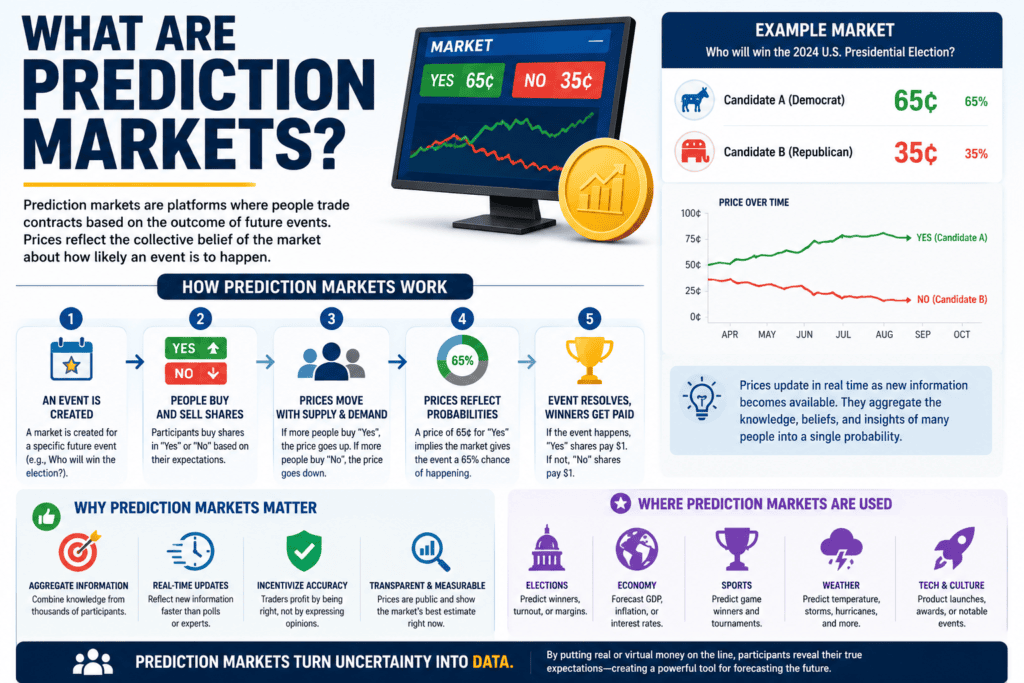
How Prediction Markets Aggregate Information
One reason prediction markets attract academic interest is their ability to combine diverse information from many participants.
Each trader may possess different knowledge:
- Local political developments
- Regional campaign activity
- Candidate performance
- Poll interpretation
- Economic trends
- Demographic shifts
When participants trade based on these insights, prices incorporate a broad range of information that no single individual necessarily possesses.
Economists often describe this as information aggregation, where dispersed knowledge becomes reflected in market prices.
Unlike polls, prediction markets reward participants for making accurate forecasts rather than expressing personal preferences.
Why Prediction Markets Sometimes Outperform Polls
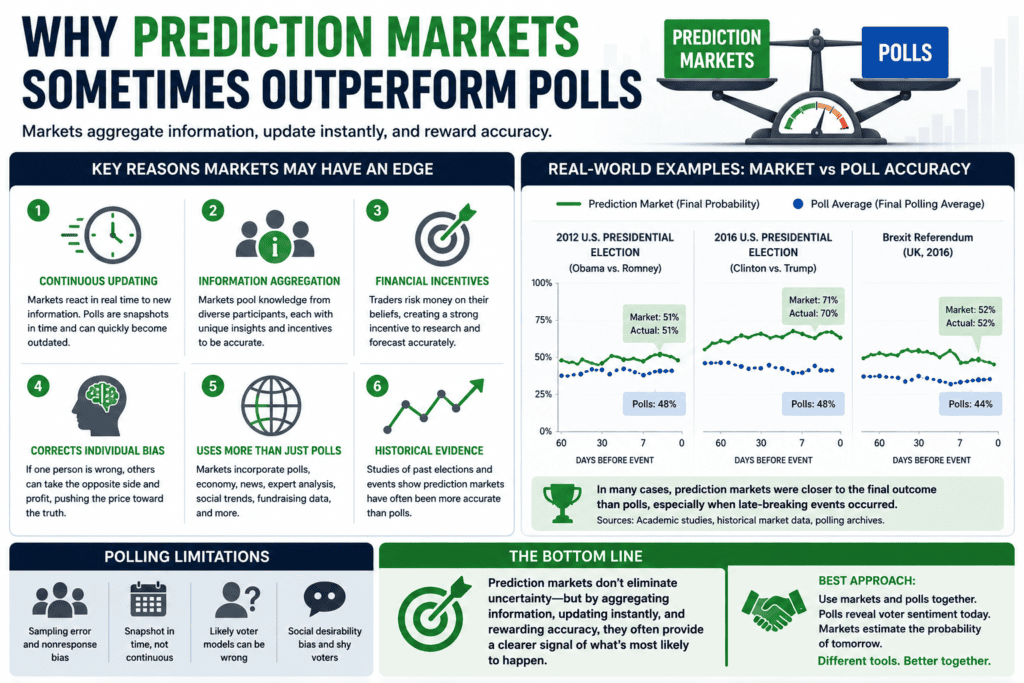
Research has found that prediction markets occasionally achieve higher forecast accuracy than individual opinion polls, particularly when elections remain weeks or months away.
Several factors contribute to this performance.
Table of Contents
Continuous Updating
Markets respond almost immediately to new information.
If unexpected economic data, campaign developments, or political events occur, market prices can change within minutes.
Polls, by contrast, require:
- Survey design
- Data collection
- Statistical weighting
- Analysis
- Publication
This process may take several days.
Incorporating Multiple Information Sources
Polls primarily measure voter intentions.
Prediction markets incorporate:
- Polls
- Historical election data
- Economic conditions
- Candidate fundraising
- Debate performances
- Expert analysis
- Political experience
This broader information base may improve forecasts under certain conditions.
Financial Incentives
Participants in many prediction markets have financial incentives to identify mispriced probabilities.
If traders believe a contract underestimates a candidate’s chances, they may purchase it, pushing the price closer to what they consider a more accurate probability.
This incentive encourages continuous reassessment of available information.
Correcting Individual Bias
Individual voters may express opinions influenced by emotion, party loyalty, or temporary reactions.
Prediction markets can partially reduce these effects because inaccurate expectations may create opportunities for other traders to profit by taking the opposite position.
While markets are not immune to bias, competitive trading can help moderate individual errors over time.
The Limitations of Opinion Polls
Despite their widespread use, polling has important limitations that readers should understand.
Sampling Error
Every survey relies on a sample rather than the full electorate.
Even well-designed polls include statistical uncertainty, commonly expressed through a margin of error.
Nonresponse Bias
Certain groups may be less likely to answer surveys.
If these groups differ politically from respondents, polling estimates may become less representative.
The Limitations of Prediction Markets
Prediction markets also face important constraints.
Limited Participation
Some markets attract relatively small numbers of traders.
A limited participant base may reduce the diversity of information reflected in prices.
Liquidity Constraints
Thin trading can produce unstable prices that react strongly to relatively small transactions.
Higher liquidity generally improves market efficiency.
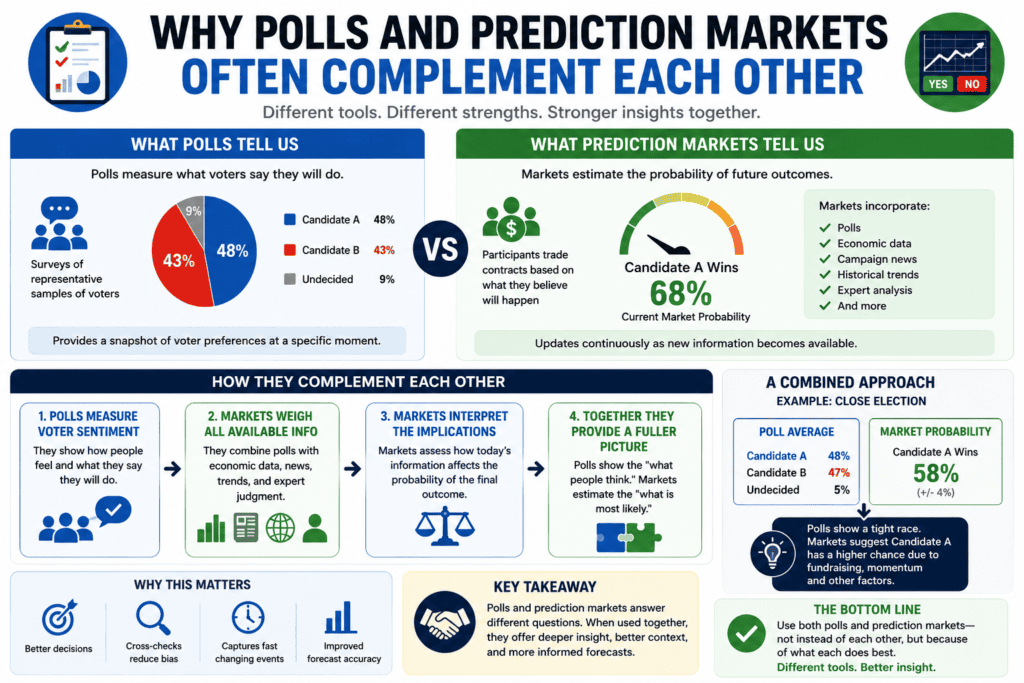
Why Polls and Prediction Markets Often Complement Each Other
Rather than viewing them as rivals, many analysts use both tools together.
Opinion polls provide direct measurements of voter preferences.
Prediction markets interpret those preferences alongside broader political, economic, and historical information.
For example:
- Polls may reveal improving support for a candidate.
- Markets assess whether that improvement is sufficient to change the probability of winning.
- Analysts compare both sources to identify consistent trends or potential disagreements requiring further investigation.
This combined approach often provides a richer understanding of election forecasting than relying on either method alone.
Conclusion
The debate over prediction markets vs polls is not about identifying a single superior forecasting method. Instead, it is about recognizing that each provides different types of information.
Opinion polls measure voter sentiment at a specific point in time, offering valuable insights into public preferences and campaign dynamics. Prediction markets estimate the probability of future outcomes by aggregating information from participants who continuously update their expectations.
Both methods have strengths and limitations. Polls remain essential for understanding public opinion, while prediction markets often provide a broader assessment that incorporates multiple sources of information. Used together, they offer a more balanced perspective on election forecasting, improve understanding of polling limitations, and contribute to more informed discussions about forecast accuracy without eliminating the uncertainty that is inherent in democratic elections.