
Food prices are one of the clearest ways people experience the economy.
Inflation figures can feel abstract until the price of maize flour, cooking oil, vegetables, or sugar changes. Then the numbers become real. Households notice immediately, businesses adjust budgets, and conversations at local markets often sound a bit different. It doesn’t take long.
So, will food prices rise in Kenya?
There isn’t a single answer because food prices respond to a combination of domestic and international forces. Rainfall, transport costs, exchange rates, fuel prices, global commodity markets, and agricultural production all influence what consumers eventually pay.
Forecasting food prices is therefore less about certainty and more about understanding probabilities.
Table of Contents
Agricultural Production Remains the Foundation
Kenya’s food supply depends heavily on domestic agricultural output.
Major crops include:
- Maize
- Beans
- Potatoes
- Rice
- Wheat
- Vegetables
- Fruits
When harvests are strong, market supply generally increases.
Higher supply often helps stabilize prices, particularly for locally produced food.
Poor harvests, however, can reduce availability and place upward pressure on prices.
Agriculture still sits at the center of Kenya’s food economy.
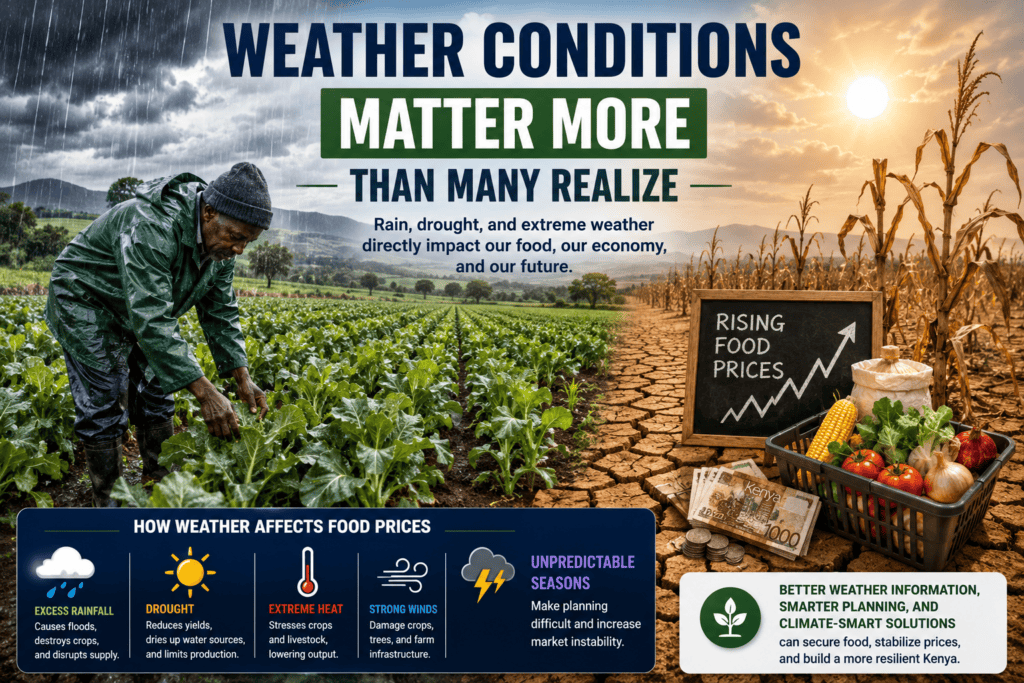
Weather Conditions Matter More Than Many Realize
Rainfall patterns remain one of the largest variables affecting food prices.
Several weather-related factors influence production:
- Seasonal rainfall
- Drought conditions
- Flooding
- Temperature changes
- Pest outbreaks
Good growing conditions usually improve harvest volumes.
Extended droughts or severe flooding can reduce production and increase market prices.
Weather forecasts therefore become surprisingly relevant to economic forecasting.
Farmers have always known this. Financial analysts increasingly do too.
Transportation Costs Affect Retail Prices
Food doesn’t simply appear on supermarket shelves.
It must be transported from farms to wholesalers, distributors, and retailers.
Transportation costs depend partly on:
- Fuel prices
- Road infrastructure
- Vehicle operating costs
- Distribution efficiency
Higher transport expenses often increase the final retail price consumers pay.
Even locally grown produce can become more expensive if logistics costs rise significantly.
Fuel Prices Influence Food Inflation
Fuel prices affect almost every stage of the food supply chain.
They influence:
- Farm machinery
- Irrigation systems
- Transportation
- Cold storage
- Distribution
- Retail operations
If fuel prices rise substantially, food prices often experience upward pressure as businesses pass part of those costs to consumers.
The relationship isn’t always immediate.
But it is difficult to avoid over time.
Inflation Extends Beyond Food
General inflation influences production costs across the economy.
Higher inflation may increase expenses related to:
- Fertilizer
- Seeds
- Packaging
- Labor
- Electricity
- Equipment maintenance
As production becomes more expensive, businesses may gradually adjust prices.
Food inflation often reflects both agricultural conditions and broader economic trends.
Exchange Rates Influence Imported Food
Kenya imports several food products and agricultural inputs.
The exchange rate therefore matters.
If the Kenyan shilling weakens against major foreign currencies:
- Imported wheat becomes more expensive.
- Cooking oil imports may cost more.
- Fertilizer prices may increase.
- Agricultural machinery becomes more costly.
A stronger shilling can have the opposite effect by reducing import costs.
Currency movements rarely determine prices alone, but they remain an important piece of the picture.
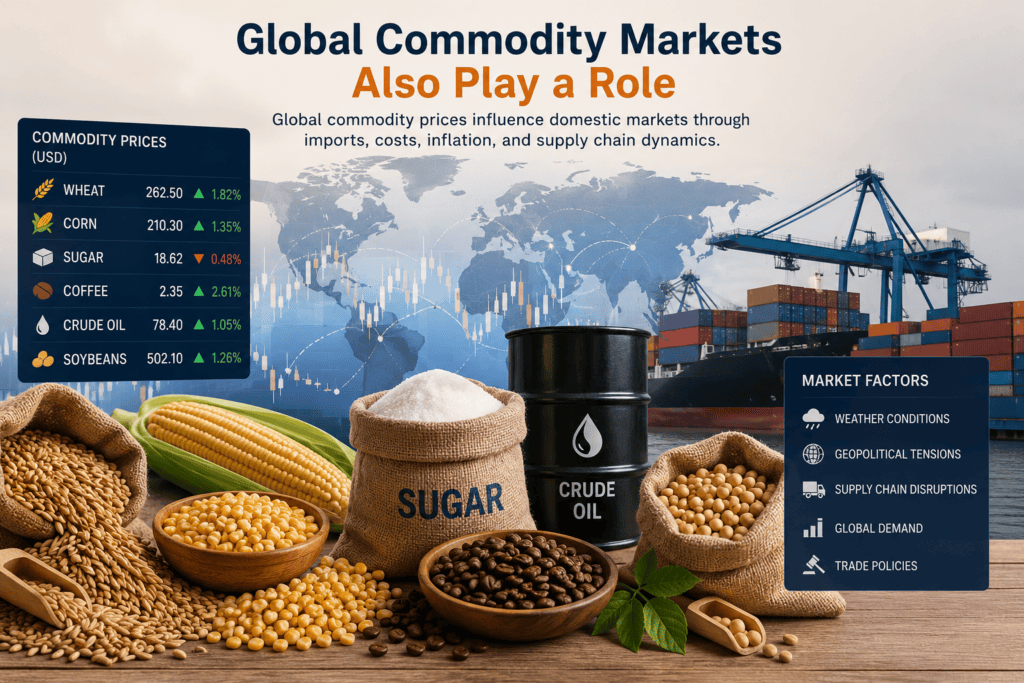
Global Commodity Markets Also Play a Role
Kenya’s food market is increasingly connected to global agricultural trade.
International prices for commodities such as:
- Wheat
- Corn
- Vegetable oils
- Sugar
- Fertilizer
can influence domestic costs.
Global events including:
- Supply disruptions
- Export restrictions
- Weather events
- Shipping costs
- Geopolitical tensions
may indirectly affect prices within Kenya.
Local markets do not operate in complete isolation.
Government Policy Can Influence Prices
Public policy occasionally affects food markets through:
- Import regulations
- Subsidy programs
- Strategic food reserves
- Agricultural investment
- Tax policy
Such measures may help moderate price volatility during periods of supply pressure.
However, long-term food price trends continue to depend largely on production, demand, and broader economic conditions.
Policy can influence markets.
It cannot completely override economic fundamentals.
Consumer Demand Matters Too
Food demand tends to remain relatively stable because it represents an essential household expense.
However, consumer behavior can still influence prices.
Factors include:
- Population growth
- Urbanization
- Household income
- Seasonal consumption
- Changes in dietary preferences
Demand often increases during holiday periods or after income growth, creating temporary pressure on certain products.
Supply and demand continue to work together.
They rarely move perfectly in sync.
Possible Scenarios for Food Prices
Forecasting is most useful when it considers multiple outcomes.
Scenario 1: Stable Prices
Food prices may remain relatively stable if:
- Rainfall supports strong harvests.
- Fuel prices remain moderate.
- Inflation stays contained.
- Transportation costs stabilize.
- Exchange rates remain relatively steady.
This scenario would likely reduce pressure on household food budgets.
Scenario 2: Moderate Price Increases
Gradual increases become more likely if:
- Inflation remains elevated.
- Transport costs rise modestly.
- The shilling weakens slightly.
- Agricultural production meets but does not exceed demand.
This represents a fairly common outcome during periods of steady economic expansion.
Scenario 3: Stronger Price Increases
Food prices could rise more significantly if:
- Severe drought reduces harvests.
- Fuel prices increase sharply.
- Fertilizer costs rise.
- Exchange rates weaken considerably.
- Global commodity prices surge.
Several of these factors occurring simultaneously would increase the probability of sustained food inflation.
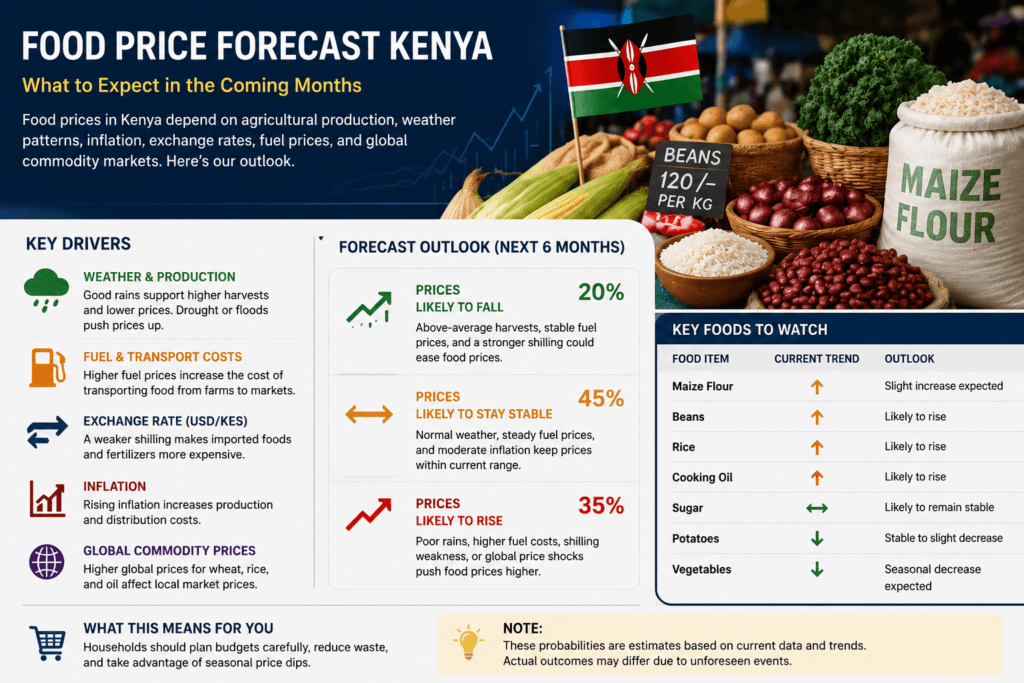
Food Price Forecast Kenya
Any responsible food price forecast Kenya should recognize that agricultural markets remain highly sensitive to changing conditions.
Current indicators suggest several supportive factors:
- Continued agricultural investment
- Improved logistics infrastructure
- Monetary policy focused on price stability
- Ongoing efforts to strengthen food production
At the same time, risks remain:
- Unpredictable weather patterns
- Global commodity price volatility
- Currency fluctuations
- Higher transport costs
- International supply disruptions
Taken together, these factors suggest that moderate food price movements appear more probable than either sustained deflation or dramatic price spikes under normal conditions.
However, agricultural markets can change quickly when weather conditions deteriorate.
What Should Analysts Watch?
Professional forecasters generally monitor several indicators simultaneously:
- Seasonal rainfall forecasts
- Crop production reports
- Inflation releases
- Fuel prices
- Exchange rate movements
- Fertilizer costs
- Global grain prices
- Transportation expenses
Looking at one indicator alone rarely tells the whole story.
Patterns across multiple datasets usually provide stronger evidence.