
Primary Keyword: betting losses Kenya
Secondary Keywords: prediction advantage, forecasting vs gambling, probability decisions
Goal: Trust
SEO Description: Learn the difference between betting and prediction markets by exploring how information, probabilities, and disciplined decision-making influence outcomes. Understand why forecasting focuses on evidence rather than chance.
Betting Losses vs Prediction Markets
Conversations about prediction markets often end up in the same place.
Someone asks, “Isn’t this basically betting?”
It’s an understandable question. On the surface, both involve future events and uncertain outcomes. But once you look at how participants make decisions, how prices are formed, and what information is being used, the similarities begin to fade.
The distinction isn’t really about whether money is involved. It’s about the process behind the decision.
That’s where things become interesting.
Table of Contents
Why Betting Losses Are So Common
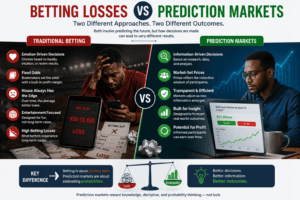
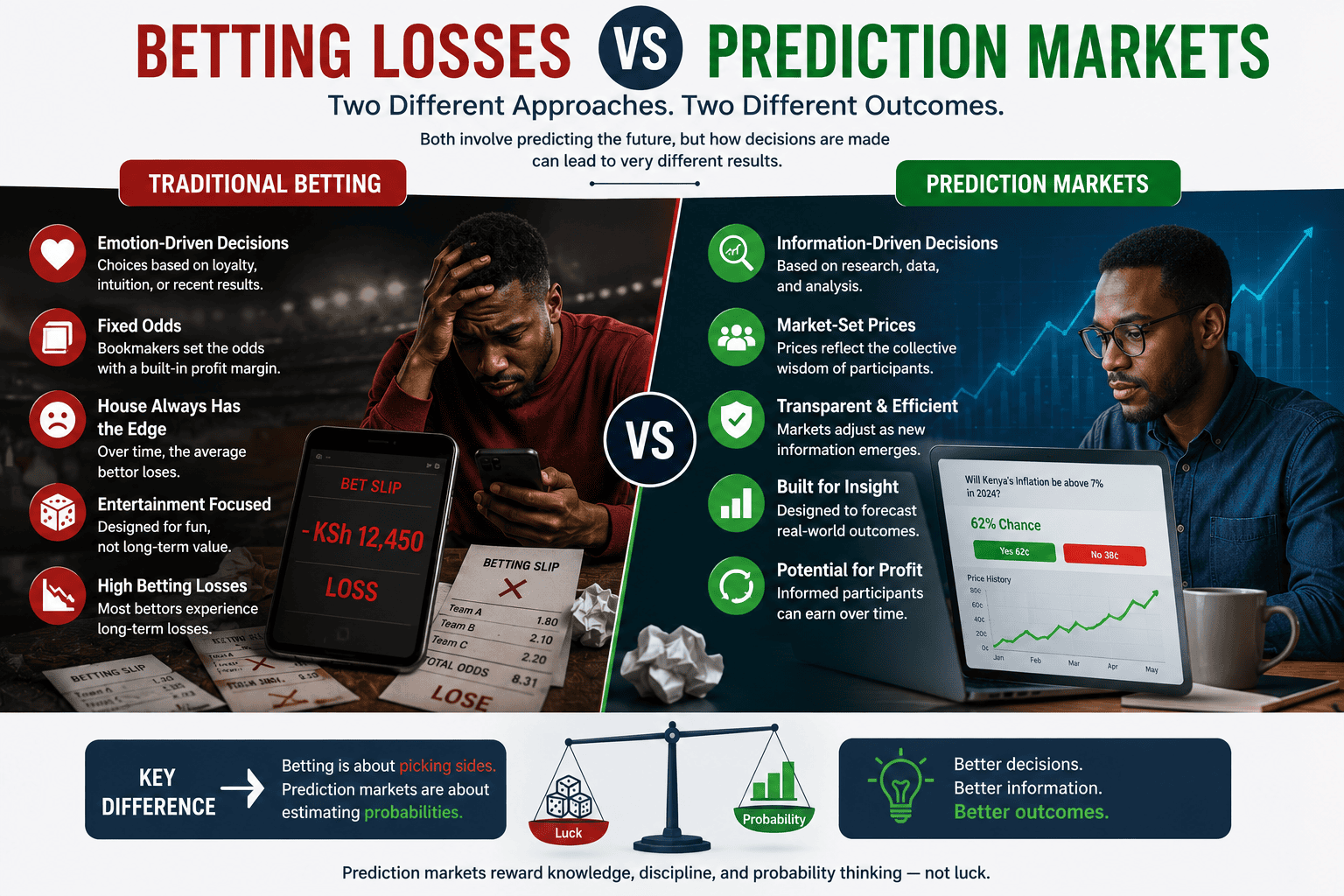
Traditional betting is usually designed around entertainment.
Participants often make decisions based on:
- Personal loyalty
- Intuition
- Recent results
- Popular opinion
- Emotional attachment
A football supporter might back their favorite club regardless of current form. Another person may bet after watching a single impressive performance. It happens more often than people admit.
Bookmakers also build margins into their odds.
Those margins mean that, over time, the average bettor is statistically expected to lose money unless they consistently identify situations where the odds are mispriced.
This is one reason discussions around betting losses Kenya continue to receive attention.
Prediction Markets Start With Information
Prediction markets approach uncertainty differently.
Participants generally begin with research rather than preference.
Information might include:
- Economic indicators
- Opinion polls
- Historical performance
- Company reports
- Weather forecasts
- Government data
- Expert analysis
The objective is not simply choosing what feels likely.
Instead, participants ask whether the market has accurately priced the available information.
Sometimes it has.
Sometimes it hasn’t.

Prices Reflect Collective Expectations
One defining feature of prediction markets is that prices move as participants trade.
Each transaction incorporates new information into the market.
For example:
- A new economic report is released.
- An election debate changes public opinion.
- A football team announces several injuries.
- A company reports stronger-than-expected earnings.
As information changes, probabilities often change as well.
The market continuously adjusts its expectations.
Probability Matters More Than Confidence
Many people confuse confidence with probability.
They are not the same thing.
A participant may feel absolutely certain about an outcome.
The evidence, however, may only support a 60% probability.
Professional forecasters try to separate belief from measurable likelihood.
This shift in thinking is one of the biggest differences between forecasting vs gambling.
Forecasting accepts uncertainty.
Gambling often encourages certainty where none exists.
Information Creates a Prediction Advantage
Prediction markets reward participants who identify information that others have overlooked or interpreted differently.
This potential prediction advantage can come from:
- Better research
- Faster analysis
- Deeper subject knowledge
- Statistical models
- Understanding incentives
- Historical context
The advantage does not guarantee success.
It simply increases the probability of making informed decisions over time.
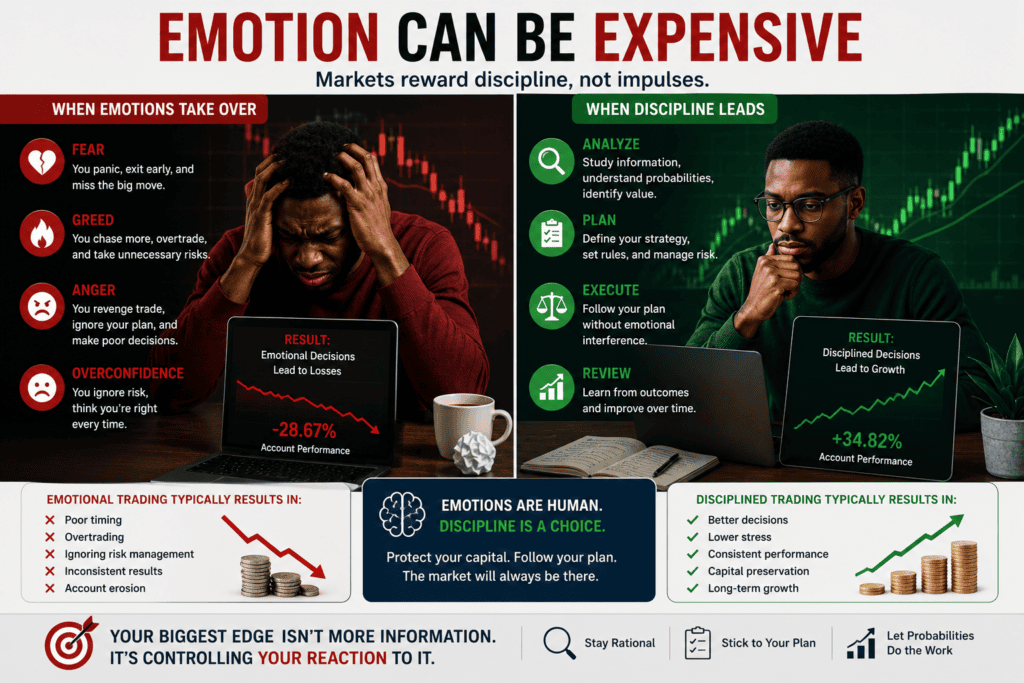
Emotion Can Be Expensive
Emotional decision-making affects both betting and forecasting.
However, experienced prediction market participants often develop systems designed to reduce emotional influence.
These may include:
- Position limits
- Written trading plans
- Probability estimates
- Risk management rules
- Performance reviews
Discipline matters because markets rarely reward emotional reactions for very long.
Everyone has biases.
Good forecasting tries to minimize their impact rather than pretend they don’t exist.
Risk Management Changes the Experience
Traditional betting often focuses on individual events.
Prediction market participants frequently think in terms of portfolios.
Instead of relying on one outcome, they may spread exposure across multiple markets involving:
- Politics
- Economics
- Technology
- Business
- Sports
Diversification cannot eliminate losses.
It can reduce the impact of any single incorrect forecast.
Markets Reward Evidence, Not Optimism
An optimistic prediction is not automatically a good prediction.
Likewise, a pessimistic forecast is not automatically realistic.
Evidence should determine probability estimates.
Professional forecasters continually ask:
- What information supports this outcome?
- What evidence contradicts it?
- Has the market already priced this information?
- What assumptions am I making?
These questions improve decision quality regardless of whether the final prediction proves correct.
Learning From Incorrect Forecasts
Both bettors and forecasters experience losses.
The difference often lies in how those losses are evaluated.
Prediction market participants frequently review:
- Their original assumptions
- Available information
- Probability estimates
- Position sizing
- Decision process
Sometimes the analysis was flawed.
Other times the probability was accurate but an unlikely outcome occurred.
Those situations should not be confused.
Probability does not eliminate surprises.
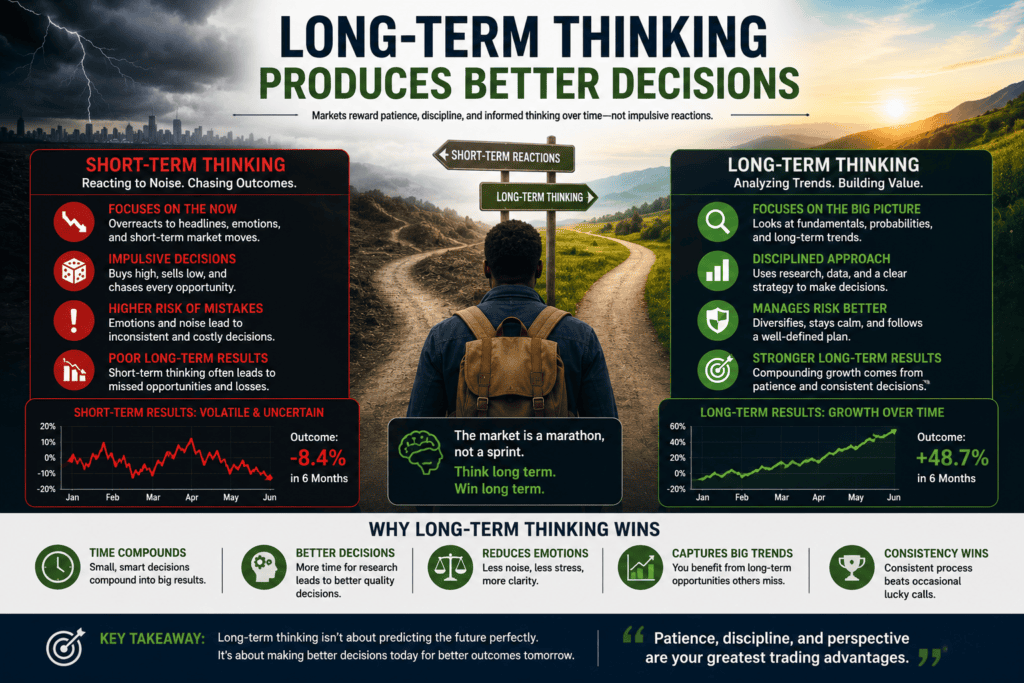
Long-Term Thinking Produces Better Decisions
Prediction markets encourage repeated decision-making over many events.
This longer perspective shifts attention toward:
- Expected value
- Consistency
- Evidence quality
- Risk-adjusted returns
- Decision discipline
A single correct prediction proves very little.
Hundreds of well-reasoned forecasts provide a much stronger indication of analytical skill.
That takes time.
There’s no shortcut around it.
Forecasting Is Not About Being Right Every Time
One of the biggest misconceptions is that successful forecasters rarely make mistakes.
In reality, uncertainty guarantees that some well-researched predictions will be wrong.
Good forecasting is not measured by perfection.
It is measured by whether probability estimates become more accurate over many observations.
That difference sounds subtle.
It changes everything.
Key Differences at a Glance
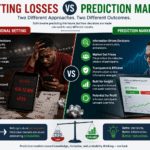
| Traditional Betting | Prediction Markets |
|---|---|
| Often driven by entertainment | Focused on information and analysis |
| Fixed bookmaker odds | Market prices adjust continuously |
| Bookmaker sets pricing | Participants collectively influence pricing |
| Emotion often drives decisions | Evidence guides probability estimates |
| Individual wagers dominate | Portfolio thinking is common |
| Limited information use | Broad data analysis is encouraged |