
A funny thing happens every time the world becomes obsessed with predicting something. It could be a major election, a World Cup final, a central bank decision, or even whether a particular company will beat earnings expectations. Suddenly everyone has a forecast. Television panels fill up with experts. Newspapers publish opinion pieces. Social media becomes one giant prediction machine where confidence seems to increase in direct proportion to uncertainty.
Then the event actually happens.
And once the outcome is known, the explanations arrive almost immediately. Analysts explain why it was obvious. Commentators point to signals they supposedly saw weeks earlier. People start rewriting their own predictions in subtle ways. If you’ve followed politics or markets for long enough, you’ve probably noticed this pattern. The future is incredibly difficult to predict until it becomes the past. Then it starts looking suspiciously straightforward.
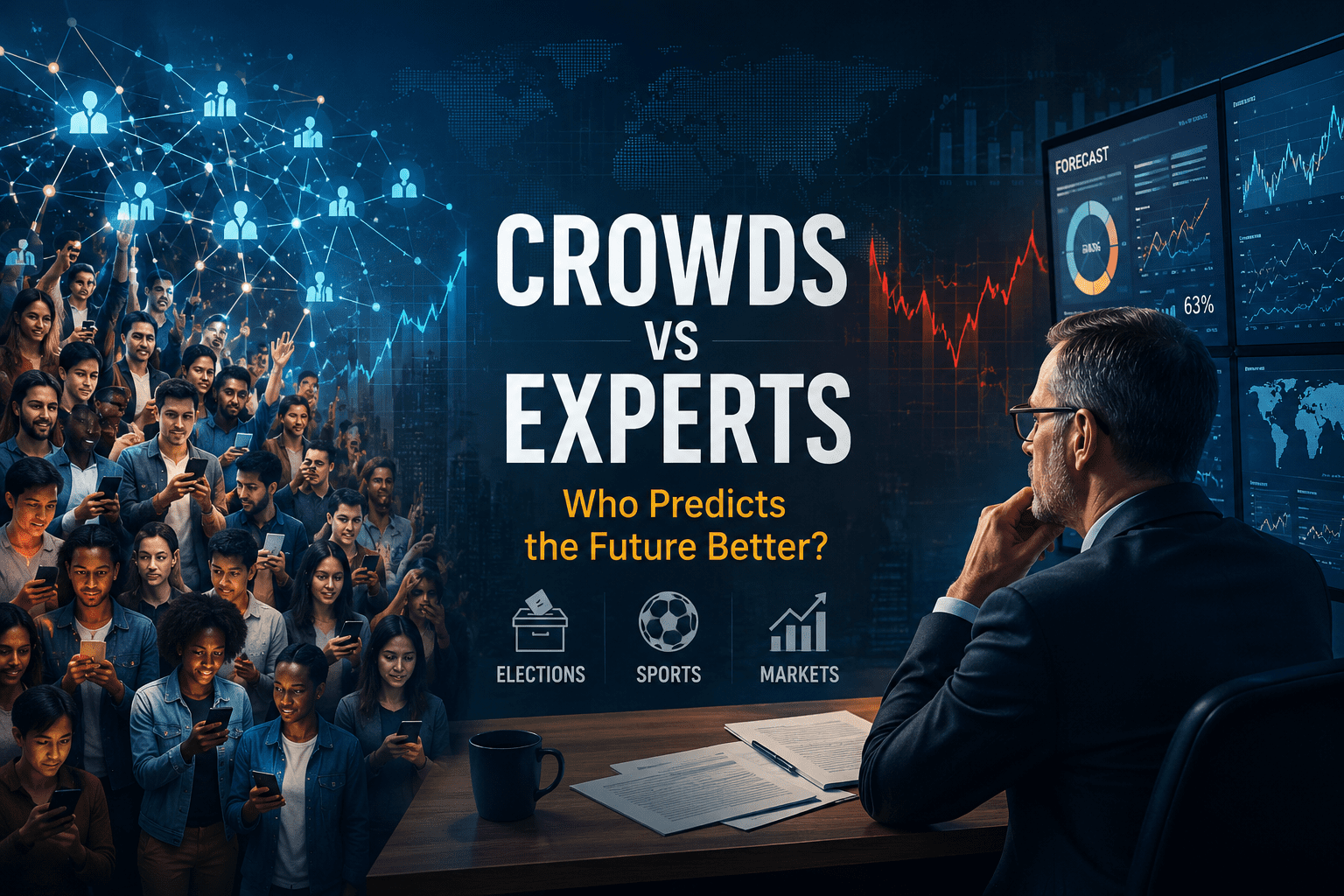
What’s interesting is that while experts are busy making individual predictions, another forecasting process is often taking place quietly in the background. Instead of relying on one highly qualified person, it relies on thousands of people contributing small pieces of information. Most of these people aren’t famous. Many aren’t specialists. Some may only know one small thing that’s relevant to the outcome. Yet when their judgments are combined, the resulting forecast can be surprisingly accurate.
Table of Contents
The Prediction Problem Experts Can’t Escape
This isn’t really a story about experts being wrong. That’s the version people usually focus on because it’s more dramatic. The real story is that forecasting is fundamentally different from explaining. Experts are often very good at explaining how things work. Economists understand inflation. Political scientists understand voting behavior. Sports analysts understand tactics and player performance.
The problem is that understanding a system and predicting a system aren’t exactly the same thing.
A political analyst might correctly understand every major issue shaping an election and still miss a late shift in voter sentiment. An economist may build a model using excellent data and still underestimate how consumers react to uncertainty. Even in sports, where information seems more visible, unexpected injuries, tactical decisions, weather conditions, and plain old luck can completely change the outcome of a match. Anyone who has watched football regularly knows this. Every season produces results that would have looked absurd a week earlier.
The future has an annoying habit of introducing information that nobody had when they made the forecast.
Why Thousands of Small Clues Matter
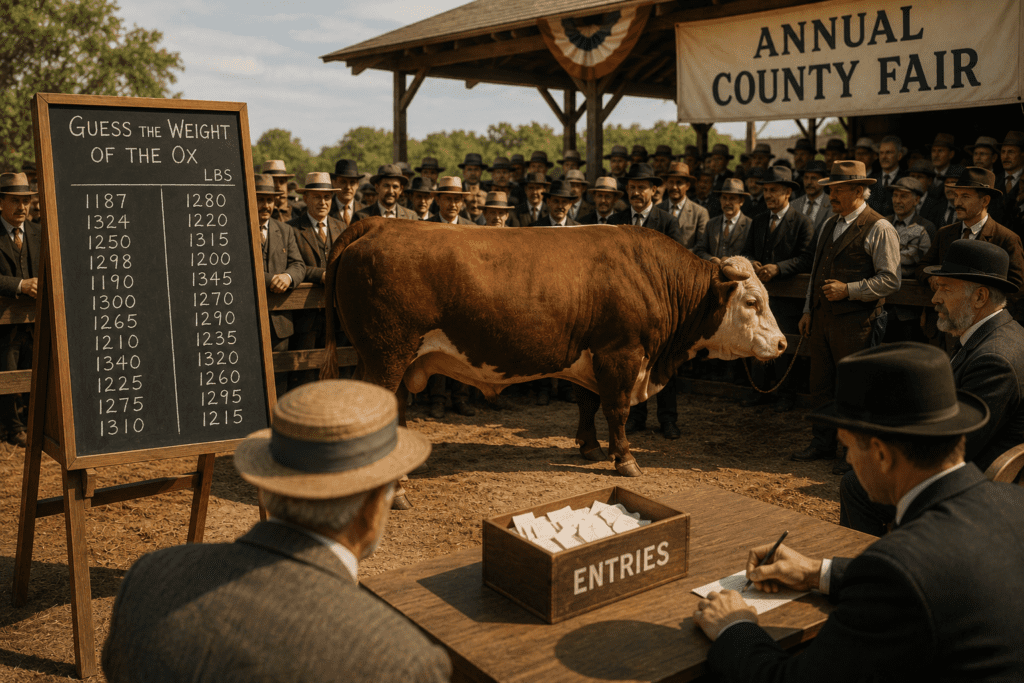
One of the most important ideas in forecasting research is surprisingly simple: useful information is scattered. Nobody has all of it.
Think about an election. A journalist might understand national trends. A local business owner might notice changing economic sentiment before it appears in official data. A campaign volunteer may detect enthusiasm that polls aren’t fully capturing. Someone else might notice turnout patterns in a particular region. None of these observations tells the whole story. Most don’t even seem particularly important on their own.
The interesting part is what happens when they’re combined.
This is where collective intelligence starts to make sense. The crowd isn’t smarter because people suddenly become geniuses when they’re grouped together. That’s not how it works. The advantage comes from diversity. Different people know different things. One person’s mistake can be offset by someone else’s insight. One person’s blind spot can be covered by another person’s experience.
Forecasting researchers have observed this effect repeatedly. When enough independent judgments are aggregated, the final prediction often performs better than most individual predictions within the group. Not always. Forecasting would be easy if it worked every time. But often enough that economists, investors, and policymakers have spent years studying it.
Elections Keep Producing the Same Lesson
Election forecasting is probably where most people first encounter the wisdom of crowds, even if they don’t realize it.
Every election cycle generates countless predictions from experts, campaigns, journalists, and political commentators. Some forecasts are based on polling data. Others rely on historical trends or demographic analysis. All of that information matters. Yet crowd-based forecasting systems frequently perform surprisingly well because they’re able to absorb information from a much wider range of participants.
A person living in a region that national reporters rarely visit may notice changes before anyone else does. Another participant might pick up shifts in economic mood. Someone else follows local political developments obsessively because, for whatever reason, that’s become their hobby. Every forecasting community contains a few people who know an astonishing amount about one very specific topic.
The result is a forecast built from many perspectives instead of one.
That’s often its biggest strength.
Why Prediction Markets Continue to Attract Attention
This idea has become increasingly important as prediction markets and forecasting platforms have expanded around the world. The appeal isn’t that they magically reveal the future. If they did, everyone using them would be rich and life would be much simpler.
Instead, they provide a way to aggregate information from large groups of people who all possess different knowledge, experiences, and assumptions. The process turns scattered observations into a probability.
That distinction matters.
Good forecasting isn’t about certainty. It’s about estimating uncertainty more accurately than alternatives.
The best forecasters in the world still get things wrong. The best prediction markets still get things wrong. That’s unavoidable. What matters is whether a forecasting system consistently produces better probability estimates than the available alternatives.
Increasingly, the evidence suggests that crowds can.
Not because crowds are always wise. Anyone who has spent ten minutes on social media knows that’s not true. But under the right conditions—when participants think independently, possess diverse information, and have a mechanism for aggregating their views—the crowd often becomes more effective than intuition suggests.
Which is slightly uncomfortable if you’re the expert.
And fascinating if you’re trying to understand how people predict the future.