
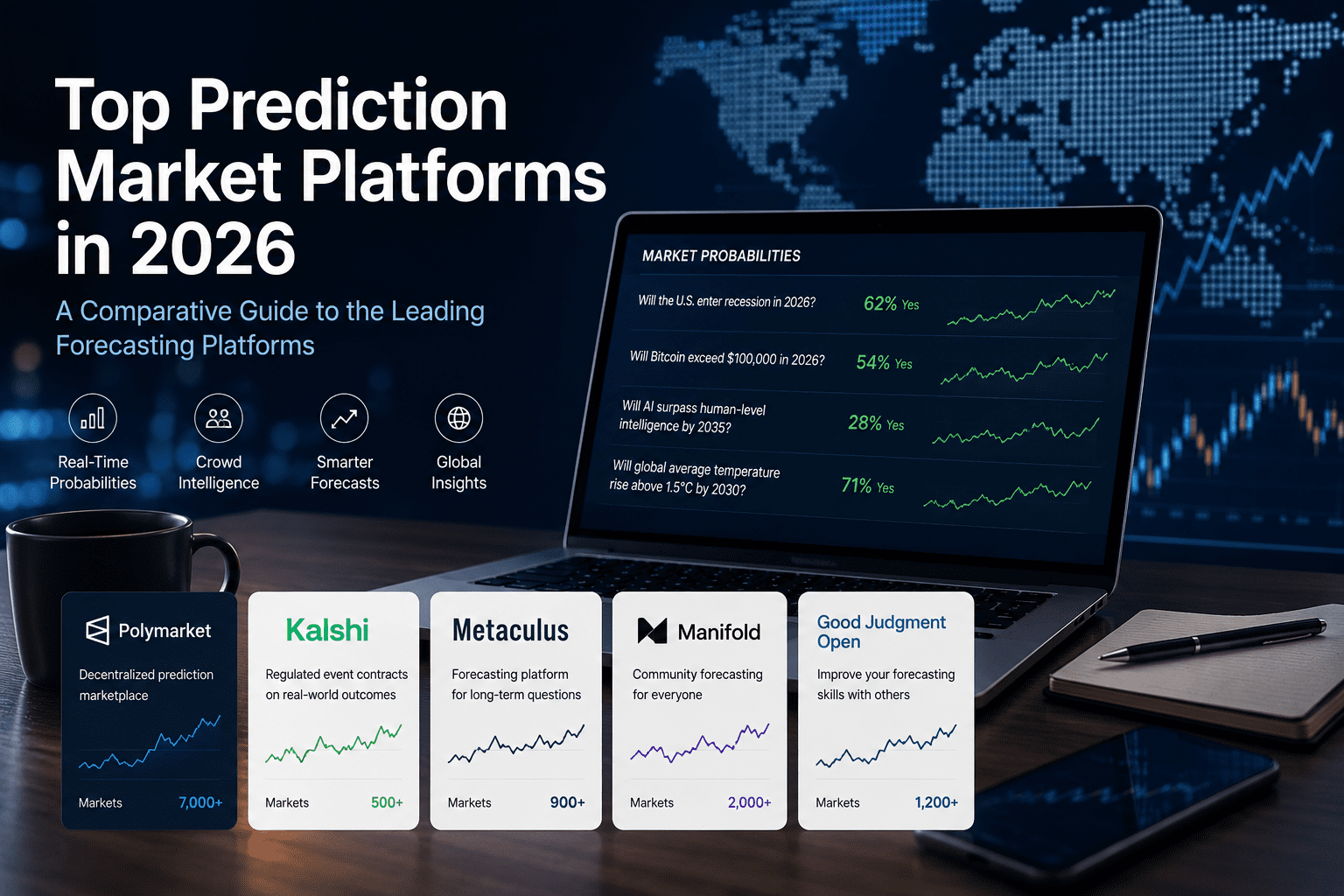
Prediction markets have quietly moved from a niche internet curiosity to something researchers, economists, journalists, and policy analysts pay attention to.
Not constantly. Nobody’s checking election probabilities while standing in line for coffee every morning. At least most people aren’t.
But over the last few years, forecasting platforms have become increasingly visible. Partly because some major world events surprised traditional experts. Partly because large groups of informed participants sometimes produce surprisingly accurate forecasts.
The basic idea is simple.
People make predictions about future events. Those predictions get aggregated into probabilities. Over time, the market reflects collective expectations about what may happen next.
Different platforms approach this in different ways. Some focus on tradable markets. Others focus on forecasting tournaments or research-driven prediction systems.
If you’re trying to understand the landscape in 2026, these are the major platforms worth knowing.
Table of Contents
1. Polymarket

Among prediction markets, Polymarket is probably the most recognizable name globally.
The platform allows participants to forecast outcomes across a wide range of topics, including:
- Politics
- Economics
- International affairs
- Technology
- Sports
- Financial events
One reason Polymarket receives attention is the sheer volume of active markets available at any given time.
You might find questions such as:
- Will a country hold elections before a certain date?
- Will inflation exceed a particular threshold?
- Will a major sporting event produce a specific outcome?
Sometimes very serious questions sit next to oddly specific ones. That’s the internet for you.
Strengths
- Large number of active markets
- Strong liquidity in major events
- Real-time probability updates
- Wide range of forecasting topics
Limitations
- Some markets can become highly news-driven
- Forecast quality varies depending on participation levels
- Certain regions face regulatory restrictions
For researchers and journalists, Polymarket is often useful as a real-time measure of public forecasting sentiment.
Not necessarily because it’s always correct.
Because it provides a continuously updating estimate of collective expectations.
2. Kalshi

Kalshi occupies a somewhat different position within the forecasting ecosystem.
Its focus is often described as event contracts tied to measurable real-world outcomes.
Examples include:
- Economic indicators
- Inflation data
- Interest rates
- Weather events
- Public policy developments
Compared to some platforms, Kalshi tends to attract attention from people interested in economic forecasting and macroeconomic trends.
Which sounds very serious until you remember there are entire debates online about future snowfall totals.
Forecasting can be unexpectedly specific.
Strengths
- Strong focus on measurable outcomes
- Economic and policy-related forecasting
- Structured market design
- Transparent event resolution
Limitations
- More limited market variety than some competitors
- Less emphasis on community forecasting discussions
For people interested in economic expectations rather than political speculation, Kalshi often provides useful forecasting signals.
3. Metaculus
Metaculus is different from both Polymarket and Kalshi.
Rather than focusing primarily on market activity, Metaculus operates as a forecasting platform built around prediction questions and community forecasts.
Participants submit probability estimates and update them as new information emerges.
The platform has become particularly popular among:
- Researchers
- Data scientists
- Academics
- Policy analysts
- Long-term forecasters
Many questions involve:
- Artificial intelligence
- Scientific developments
- Global risks
- Technology adoption
- Demographic trends
Some forecasts extend years into the future.
Which can feel slightly intimidating if you’re still struggling to predict next week’s weather.
Strengths
- Research-oriented forecasting culture
- Strong community participation
- Long-term forecasting questions
- Extensive historical forecast data
Limitations
- Less intuitive for beginners
- More analytical than mainstream
- Lower public visibility compared to larger market platforms
For educational purposes, Metaculus remains one of the most interesting forecasting communities available today.
4. Manifold Markets

Manifold Markets takes a more experimental approach.
The platform emphasizes participation and forecasting practice while reducing some of the barriers associated with traditional prediction markets.
Its community frequently explores:
- Technology
- Politics
- Internet culture
- Current events
- Science
Forecasts often move quickly as users react to new developments.
Sometimes very quickly.
If you’ve ever watched internet communities discover breaking news in real time, you’ll understand the dynamic.
Strengths
- Accessible for beginners
- Active forecasting community
- Wide variety of questions
- Educational forecasting environment
Limitations
- Lower financial stakes than some platforms
- Market activity varies significantly by topic
Many people use Manifold primarily as a forecasting practice environment rather than as a source of market-based expectations.
5. Good Judgment Open
Good Judgment Open emerged from forecasting research and the broader study of prediction accuracy.
The platform focuses heavily on forecasting skill development.
Participants answer questions about future events and refine their estimates over time.
The emphasis is less on market activity and more on improving forecasting performance.
That’s an important distinction.
Many forecasting researchers view prediction as a skill that can be measured, evaluated, and improved through practice.
Strengths
- Strong educational value
- Forecasting skill development
- Research-based foundations
- Community learning environment
Limitations
- Less dynamic than market-based platforms
- Smaller public profile
For people interested in becoming better forecasters rather than following market activity, Good Judgment Open remains highly respected.
Comparing the Leading Forecasting Platforms
| Platform | Best For | Focus Area |
|---|---|---|
| Polymarket | Real-time event forecasting | Politics, economics, current events |
| Kalshi | Economic expectations | Economic and policy outcomes |
| Metaculus | Research forecasting | Science, technology, long-term trends |
| Manifold Markets | Community forecasting | Current events and experimentation |
| Good Judgment Open | Forecasting education | Skill development and research |
No single platform is objectively “best.”
The answer depends on what you’re trying to learn.
Someone interested in economic indicators may prefer Kalshi.
A researcher studying long-term technological change may gravitate toward Metaculus.
A journalist monitoring election expectations may find Polymarket useful.
A forecasting enthusiast interested in improving prediction accuracy may prefer Good Judgment Open.
Different tools serve different purposes.
Why These Platforms Matter
Prediction markets are often discussed as alternatives to traditional forecasting methods, but that’s not quite right.
They’re better understood as additional sources of information.
Polls measure public opinion.
Economic models estimate future outcomes using historical relationships.
Expert analysis provides interpretation.
Forecasting markets contribute another signal by aggregating expectations from participants responding to new information.
Sometimes these signals align.
Sometimes they don’t.
Those disagreements can be informative.
When markets, experts, and polls point in different directions, it often reveals uncertainty that deserves closer attention.
Final Thoughts
The best prediction markets and forecasting platforms in 2026 aren’t necessarily competing to replace traditional analysis.
Instead, they’re becoming part of a broader forecasting ecosystem.
Researchers use them.
Journalists reference them.
Policy analysts monitor them.
And increasingly, ordinary people interested in understanding uncertainty are paying attention as well.
Forecasting remains imperfect. It always will be.
But platforms that aggregate information and probabilities offer a useful window into how people collectively think about the future.
That’s ultimately what makes them interesting.
Not because they predict everything correctly.
Because they provide a structured way to think about uncertainty in a world that rarely offers certainty.