

If you search for ways to make money online in Kenya, you’ll quickly run into two extremes.
One side promises you’ll make KSh 100,000 a week from your phone with almost no effort. The other side acts like online income is impossible unless you’re a software engineer working for a company in Silicon Valley.
Reality is somewhere in the middle.
There are people in Kenya earning a full-time income online. There are also thousands spending months chasing shortcuts that never really lead anywhere. Both things are true at the same time.
The internet has made it easier to access global opportunities, but it hasn’t changed a basic fact: people still get paid for creating value, solving problems, or having useful skills.
That’s probably less exciting than some YouTube thumbnails. Still.
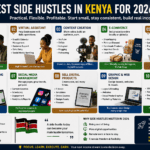
Here are some of the most realistic ways to make money online in Kenya in 2026.
Table of Contents
1. Freelancing
Freelancing remains one of the most accessible online income opportunities for Kenyans.
The reason is fairly simple. You don’t need startup capital. You don’t need a warehouse. You don’t even need a perfect laptop in some cases.
You need a skill that someone is willing to pay for.
Common freelance services include:
- Writing
- Graphic design
- Video editing
- Virtual assistance
- Social media management
- Translation
- Bookkeeping
- Software development
- Data analysis
Many freelancers start by taking small projects before gradually building a portfolio.
The difficult part isn’t usually the work itself. It’s finding the first few clients.
A lot of successful freelancers will tell you the same thing. The first KSh 5,000 online often feels harder than the next KSh 50,000.
That’s because you’re learning how to market your skills, communicate professionally, and deliver work consistently.
2. Remote Employment
Remote work is different from freelancing.
Instead of juggling multiple clients, you’re employed by a company while working online.
This has become increasingly common across industries such as:
- Customer support
- Marketing
- Finance
- Operations
- Research
- Software engineering
- Product management
Many international companies now hire talent regardless of location, particularly for digital roles.
For Kenyan professionals, remote jobs can sometimes provide access to salaries that would be difficult to find locally, although competition is also much higher.
One thing worth mentioning.
Remote work sounds flexible until you’ve spent three hours in back-to-back meetings while your internet connection decides to become philosophical about life.
It happens.
3. Content Creation
Content creation has matured considerably over the past few years.
It’s no longer limited to influencers posting lifestyle content.
People now build audiences around:
- Business analysis
- Personal finance
- Technology
- Sports
- Agriculture
- Education
- Gaming
- Local news
Income can come from:
- Advertising revenue
- Sponsorships
- Memberships
- Consulting
- Affiliate partnerships
- Digital products
The challenge is consistency.
Most creators quit before they gain meaningful traction.
Building an audience often takes months or years rather than weeks.
That part rarely appears in success stories.
4. Selling Digital Services
Digital services remain one of the strongest online business models because they require relatively little capital.
Examples include:
- Website design
- SEO consulting
- Copywriting
- Digital marketing
- Business research
- Data visualization
- Financial modelling
Businesses increasingly need these services as more operations move online.
The opportunity isn’t necessarily in becoming an expert overnight.
It’s often about becoming reliably good at solving a specific problem.
A surprising number of businesses simply want someone who responds to emails on time and delivers what they promised.
That sounds obvious. Yet here we are.
5. Online Tutoring and Education
Kenya has a large pool of educated professionals who can teach online.
Subjects commonly taught include:
- Mathematics
- English
- Science
- Coding
- Exam preparation
- Professional certifications
The rise of virtual learning has expanded opportunities far beyond local geography.
A tutor in Nairobi can now teach students in Mombasa, London, Johannesburg, or Dubai without leaving home.
The market is competitive, but demand for quality instruction remains strong.
Particularly in specialized subjects.
6. Building Digital Products
Some people prefer creating assets that can generate income repeatedly.
Examples include:
- Online courses
- E-books
- Templates
- Research reports
- Educational guides
- Subscription newsletters
The advantage is scalability.
The downside is that creating useful products requires significant upfront effort.
Many digital products never gain traction because they solve problems nobody actually has.
Market research matters more than people sometimes assume.
7. Participating in Forecasting and Information Markets
A newer category attracting attention globally involves forecasting platforms and information markets.
These platforms focus on estimating the likelihood of future events.
Examples might include questions related to:
- Elections
- Economic indicators
- Sports outcomes
- Public policy developments
- Technology trends
The underlying idea is that people with useful information or strong analytical skills may contribute forecasts that reflect collective expectations.
It’s worth noting that forecasting is fundamentally different from simply making guesses.
Good forecasters tend to:
- Follow data closely
- Update views when new information emerges
- Understand uncertainty
- Think probabilistically
Research over the past two decades has shown that forecasting skill can be developed and measured.
Some individuals consistently produce more accurate forecasts than others.
That finding surprised many researchers initially.
It still surprises people now.
8. Data and Research Work
As organizations become increasingly data-driven, demand for research and analytical work continues to grow.
This includes:
- Market research
- Survey analysis
- Economic research
- Competitive intelligence
- Public policy analysis
For people who enjoy investigating trends, reading reports, and working with information, this can be a valuable online career path.
Not everyone enjoys spreadsheets.
Some people genuinely do, though. Those people seem unusually happy when they discover a new dataset.
Which Option Is Best?
There isn’t a universal answer.
The best online income opportunity depends on:
- Your existing skills
- Available time
- Financial goals
- Risk tolerance
- Personal interests
For many people, freelancing or remote work offers the most practical starting point.
For others, content creation or digital products may make more sense as long-term projects.
The common thread across nearly all successful online income stories is surprisingly ordinary.
People develop useful skills.
They solve real problems.
They stay consistent longer than expected.
That’s usually less dramatic than internet marketing suggests, but it tends to be closer to reality.
Final Thoughts
The online economy in Kenya continues to expand.
New opportunities emerge every year while older ones evolve or disappear.
The important thing isn’t finding a secret method that nobody else knows about.
It’s identifying opportunities that fit your skills and investing enough time to become genuinely useful.
Online income is real.
Easy money, usually less so.
And honestly, that’s probably a good thing.