
Election season always brings an avalanche of numbers.
One poll says Candidate A is leading. Another puts Candidate B ahead by three points. Television panels spend hours debating tiny changes that fall well within the margin of error, and social media somehow becomes even more confident than usual.
Then, every so often, the result surprises everyone.
When that happens, the conversation often turns to the same question: Were the polls wrong?
Sometimes they were. Sometimes they weren’t. More often, they were simply measuring something different from what people expected.
That’s where prediction markets enter the discussion.
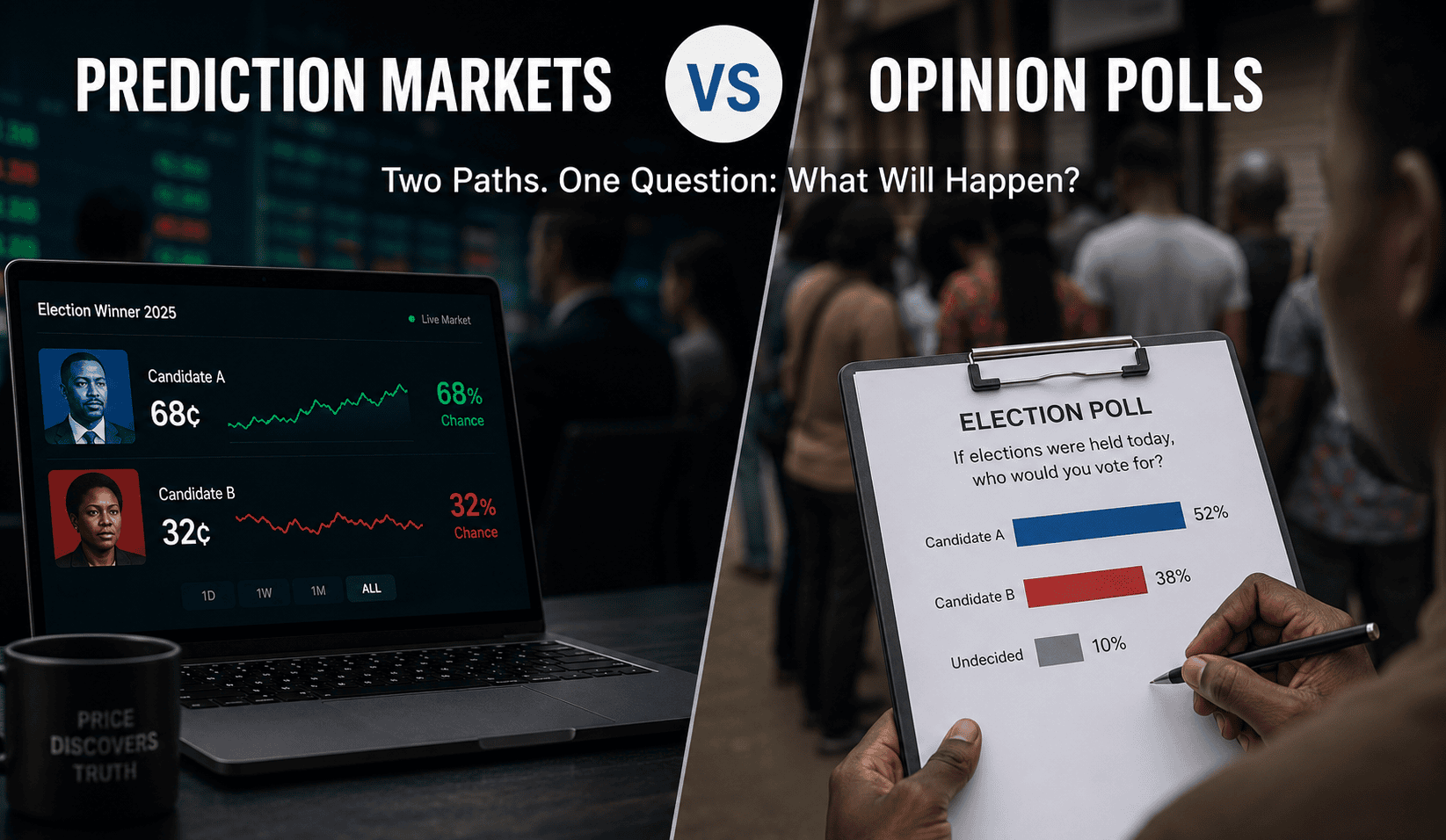
Although opinion polls and prediction markets are both used to understand future events, they answer different questions. Understanding that difference is important because they’re often compared as though they’re trying to do exactly the same job.
They’re not.
Table of Contents
What Opinion Polls Actually Measure
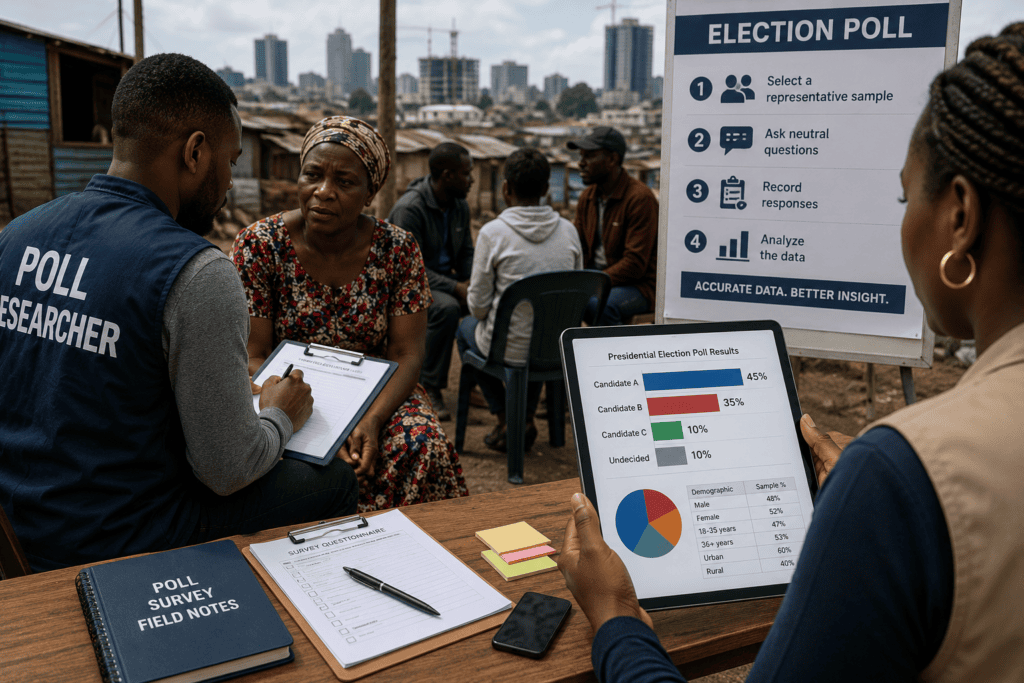
An opinion poll is essentially a snapshot.
Researchers ask a sample of people what they think or how they intend to vote at a particular moment. If the survey is designed well, that sample can provide useful insight into broader public opinion.
The important phrase there is at a particular moment.
People change their minds.
Some voters remain undecided until the final days of a campaign. Others say one thing to pollsters and do something different when election day arrives. Turnout also matters. A poll might correctly identify voting preferences while still failing to predict who actually shows up to vote.
That doesn’t make polling unreliable.
It simply means polling measures current public opinion, not the future itself.
Those are related ideas, but they aren’t identical.
What Prediction Markets Measure
Prediction markets take a different approach.
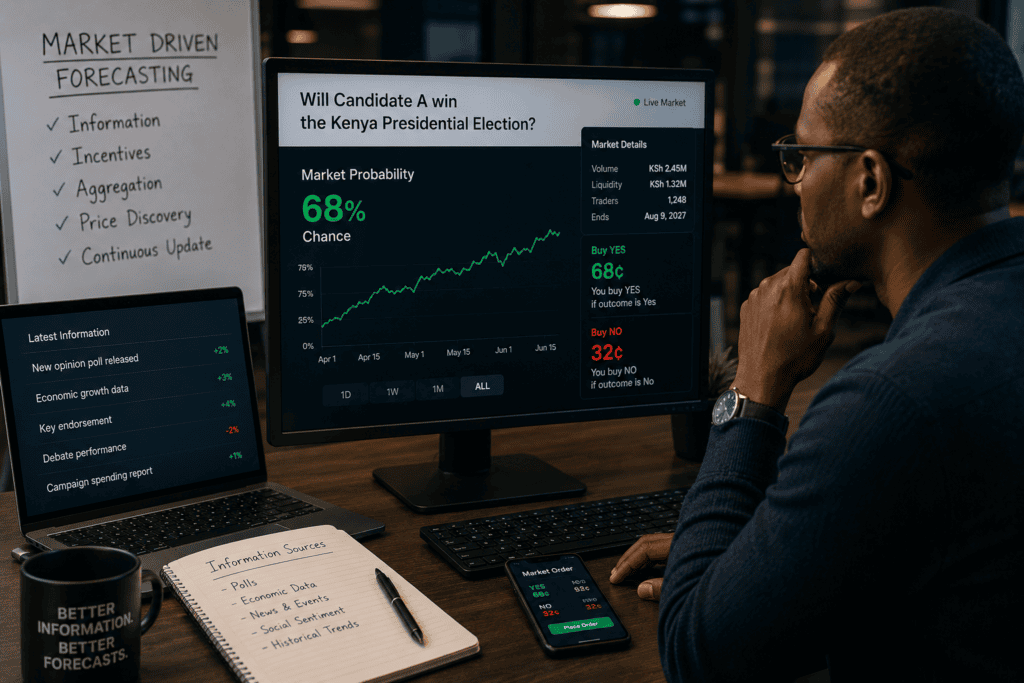
Instead of asking people what they believe today, they ask participants to estimate the likelihood of a future outcome.
Every trade reflects someone’s assessment of probability.
If a market gives a presidential candidate a 70% chance of winning, that isn’t a guarantee they’ll win. It’s the market’s collective estimate based on everything participants currently know.
That information can include opinion polls.
But it can also include economic data, campaign financing, debate performances, historical voting patterns, breaking news, and countless smaller signals that are difficult to measure individually.
In other words, prediction markets don’t replace polls.
They build on them.
Why Markets Sometimes Outperform Polls
This is the part that attracts the most attention.
Researchers have found that prediction markets have, in some cases, produced forecasts that were as accurate as—or even more accurate than—traditional polling, particularly as election day approaches.
Why?
One reason is that markets encourage participants to constantly update their views as new information becomes available.
A fresh economic report is released.
Market prices adjust.
A candidate performs poorly during a televised debate.
Probabilities shift again.
Polling, by contrast, usually updates in intervals. A survey might take several days to conduct before the results are published.
Markets react almost immediately.
That speed can be valuable when events change quickly.
Markets Aggregate More Than Opinions
There’s another difference that often goes unnoticed.
Polls collect answers.
Prediction markets collect judgments.
That may sound like the same thing, but it isn’t.
Imagine someone who believes a football team is likely to win because they’ve watched every match this season. Another participant might focus on injury reports. Someone else specializes in weather conditions or tactical analysis.
Each person brings different information.
The market combines all those perspectives into a single probability.
Economists sometimes refer to this as information aggregation.
No individual knows everything.
Collectively, the market may capture more information than any single participant possesses.
At least in theory.
Polls Still Matter
It’s tempting to frame this as a competition.
Markets versus polls.
One wins. The other loses.
Reality is less dramatic.
Prediction markets frequently rely on polling data as one of many inputs. Without reliable polling, markets would lose an important source of information.
Likewise, pollsters continue improving their methods after every election, refining sampling techniques and adjusting for demographic changes.
Neither system is perfect.
Both continue evolving.
That’s probably a healthier way to think about it.
Where Prediction Markets Can Struggle
Prediction markets aren’t automatically more accurate.
Their quality depends on participation.
Markets with limited activity may not reflect the full range of available information. If only a small number of people are trading, prices can become less informative.
They can also react emotionally.
Just like financial markets, prediction markets sometimes overreact to dramatic headlines before settling back once more information becomes available.
Human psychology doesn’t disappear simply because probabilities are involved.
People still become overconfident.
They still chase narratives.
Markets are made of humans, after all.
The African Perspective On Prediction Markets Vs Opinion Polls
Prediction markets remain relatively new across much of Africa, including Kenya.
Election analysis has traditionally relied on polling organisations, political analysts, and media commentary. Those sources remain valuable, but forecasting markets offer an additional way to interpret uncertainty.
Imagine a future Kenyan election where polling data, economic indicators, campaign events, and expert analysis all feed into active prediction markets.
Rather than replacing existing methods, forecasting markets could complement them by continuously updating probabilities as new information emerges.
That would provide another lens through which journalists, researchers, businesses, and citizens could understand changing expectations.
It’s an interesting possibility.
We’re not quite there yet.
But the conversation has already started.
So Which One Is Better?
The better question might be whether they should be competing at all.
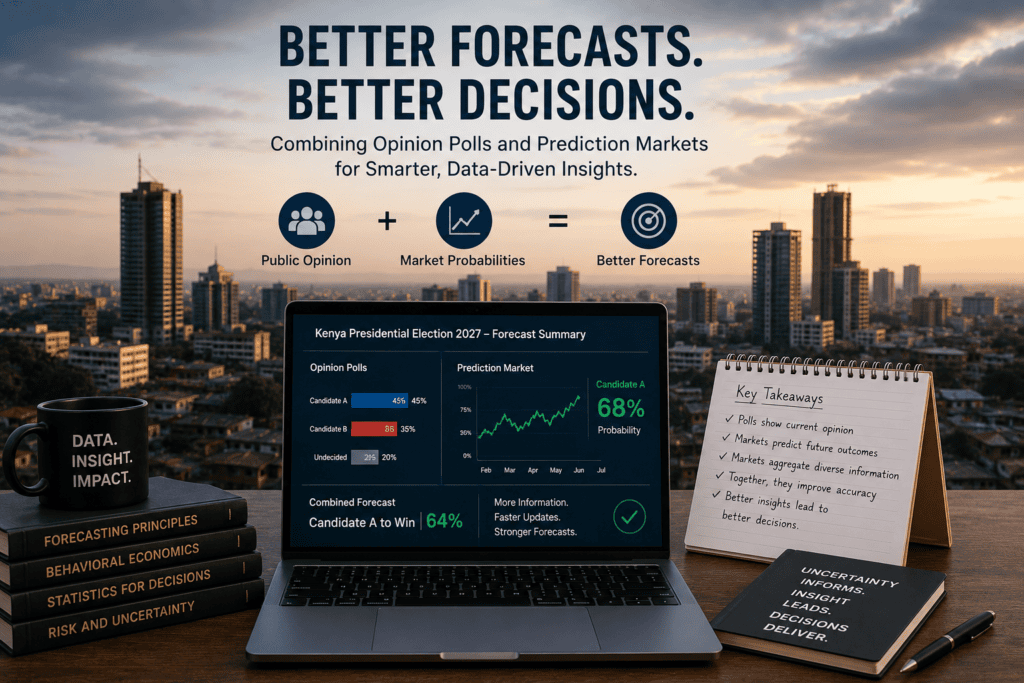
Opinion polls tell us what people are thinking today.
Prediction markets estimate what is likely to happen tomorrow.
Those are different questions with different purposes.
When both point in the same direction, confidence in the forecast often increases.
When they disagree, that’s usually where things become most interesting.
The disagreement forces analysts to ask why.
Has public opinion shifted faster than polling can capture?
Is the market reacting to information the surveys haven’t reflected yet?
Or has the market become too optimistic—or too pessimistic?
Those moments often reveal more than agreement ever could.
Final Thoughts
Forecasting is rarely about finding one perfect tool.
It’s about combining evidence thoughtfully.
Opinion polls remain one of the most valuable ways to understand public sentiment. Prediction markets add another layer by translating diverse information into continuously updated probabilities.
Neither predicts the future with certainty.
Neither should be expected to.
But together they provide a richer picture of uncertainty than either could offer alone.
And perhaps that’s the most useful lesson.
Good forecasting isn’t about choosing between competing sources of information.
It’s about learning how to interpret all of them.