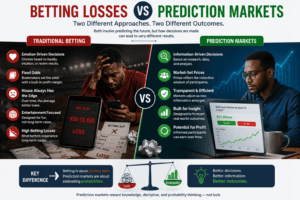

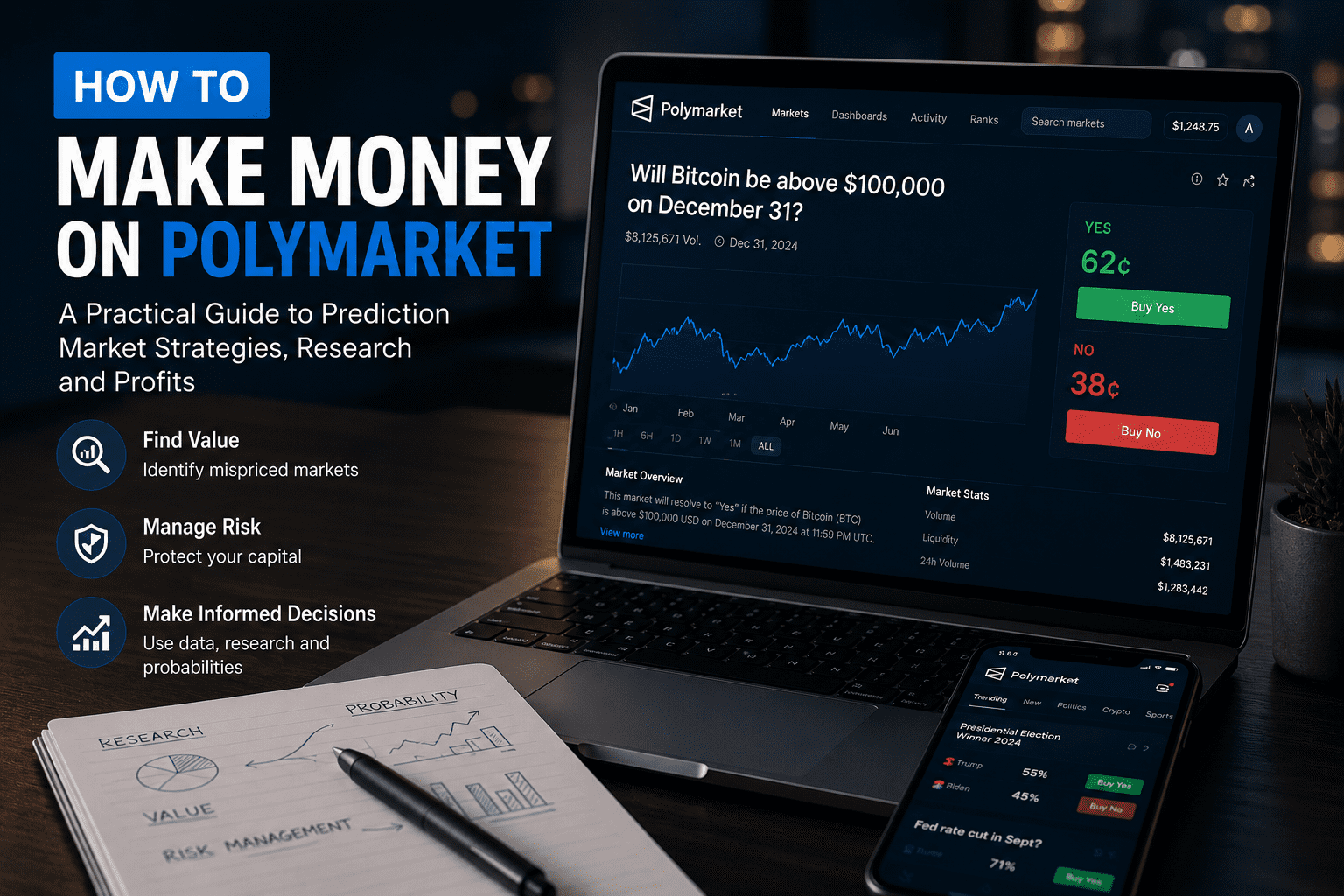
Search “how to make money on Polymarket” and you’ll notice something almost immediately. Half the internet makes it sound like anyone can make easy money. The other half argues the opposite—that prediction markets are too efficient to beat.
Neither view tells the whole story.
The reality sits somewhere in the middle. Polymarket isn’t a shortcut to making money online, but it also isn’t reserved for economists or professional traders. Like most markets, success comes from consistently making better decisions than the average participant. That’s much harder than it sounds, but it’s also what makes prediction markets interesting.
Table of Contents
What Is Polymarket?
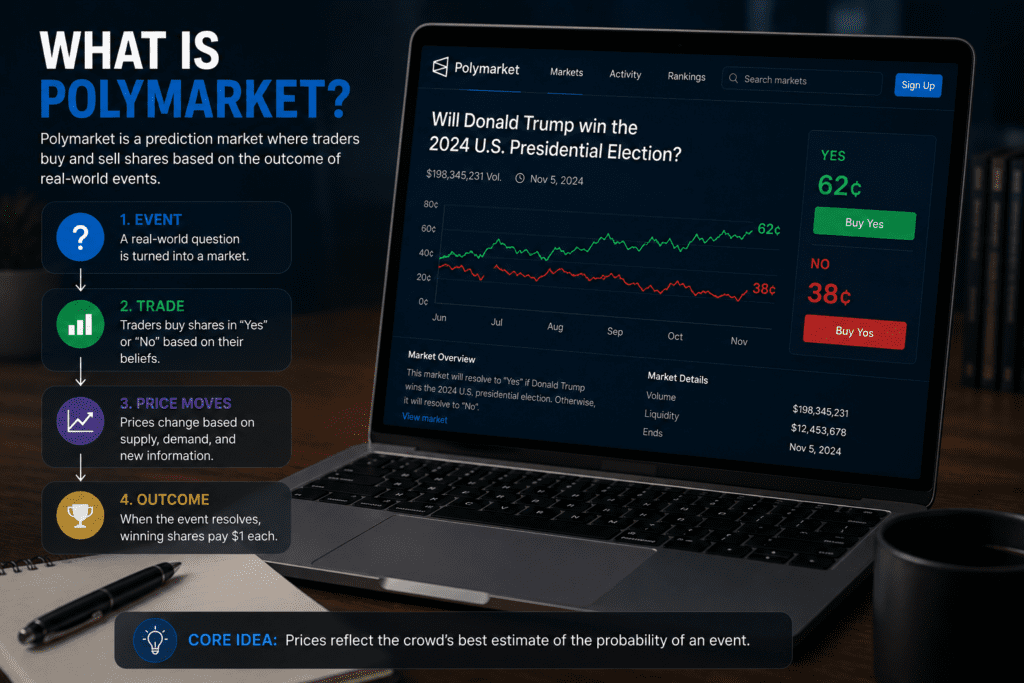
Polymarket is a prediction market where people trade contracts based on future events.
Those events can range from elections and economic data to sporting competitions, technology announcements, or international affairs. Instead of buying shares in a company, participants buy positions that reflect whether they believe an event is likely to happen.
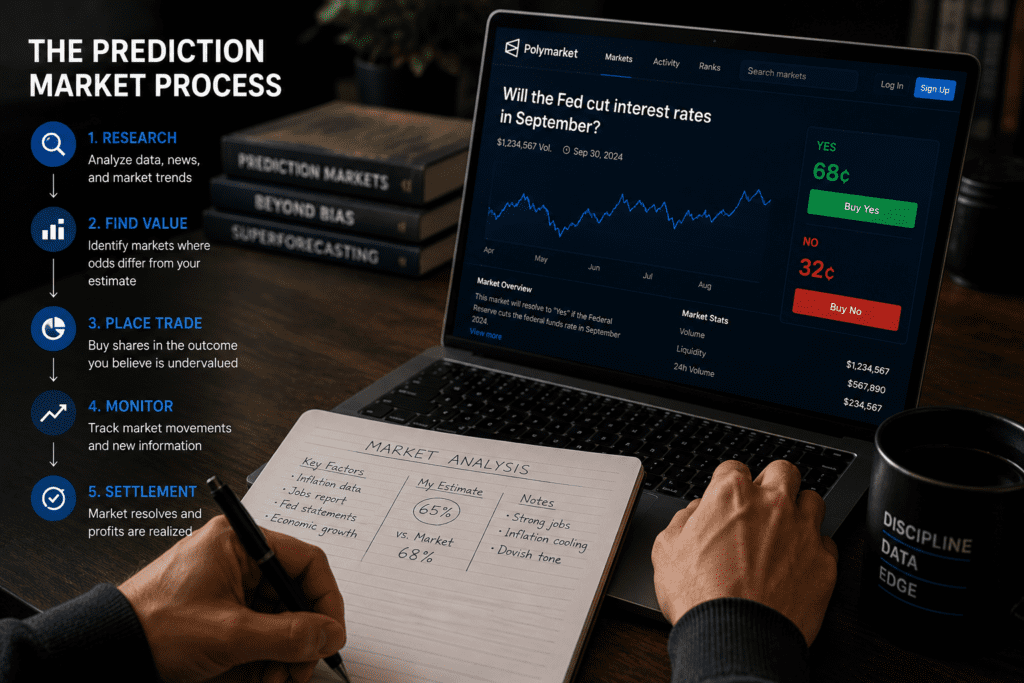
If the market currently believes an event has a 40% chance of occurring, and you think that probability should really be closer to 60%, you can take a position based on that difference.
That’s the core idea.
You’re not simply predicting the future. You’re deciding whether the market has priced uncertainty correctly.
It sounds subtle, but it’s an important distinction.
Prediction Markets Reward Better Estimates, Not Better Guesses
One mistake beginners often make is treating prediction markets like a series of yes-or-no questions.
Will this team win?
Will inflation rise?
Will a candidate be elected?
Experienced forecasters think differently. They’re less interested in the final answer than in whether the current market probability accurately reflects reality.
Imagine a football match where one team is given an 80% chance of winning.
Could they still lose?
Absolutely.
An 80% probability doesn’t mean something is guaranteed. It simply means that, over many similar situations, you’d expect that outcome to happen about eight times out of ten.
That’s how probabilities work.
Prediction markets are really about estimating those probabilities more accurately than the crowd.
Research Is Usually the Real Advantage
People sometimes imagine successful traders have access to secret information.
Most don’t.
The advantage usually comes from interpreting public information more carefully than everyone else.
Economic reports, opinion polls, injury updates, company announcements, weather forecasts, exchange rates, central bank decisions—none of these are hidden. Anyone can read them.
The difference is in connecting them.
Someone following Kenya’s inflation outlook, for example, might combine recent food price data, exchange rate movements, fuel prices, and Central Bank commentary before deciding whether the market is underestimating inflation risks.
That process is much less exciting than internet marketing makes it sound.
It’s also much closer to reality.
Learn to Think in Probabilities
Forecasting is less about certainty and more about uncertainty.
That’s one of the hardest habits to develop.
People naturally want definitive answers. We like saying something will happen.
Forecasting asks a different question.
How likely is it?
The distinction matters because uncertainty never disappears. New information arrives every day. A political debate changes public opinion. A company delays an announcement. A key player gets injured during training. Suddenly yesterday’s forecast needs updating.
Good forecasters aren’t attached to being right.
They’re attached to having the most accurate view based on the information available today.
Those aren’t always the same thing.
Risk Management Matters More Than Most People Realize
Even excellent forecasts fail.
That’s simply how probability works.
An event you believe has an 85% chance of happening will still fail occasionally. If your strategy depends on being right every single time, eventually the numbers catch up with you.
This is why experienced market participants pay so much attention to risk management.
Rather than committing everything to one prediction, they spread their exposure across different markets and avoid making emotionally driven decisions after a win or a loss.
It’s not particularly exciting advice.
But neither is wearing a seatbelt until you need one.
Don’t Confuse Confidence With Accuracy
Prediction markets have a way of exposing overconfidence.
Someone who sounds absolutely certain isn’t necessarily making the better forecast.
In fact, many experienced forecasters are surprisingly cautious.
Instead of saying, “This will definitely happen,” they’re more likely to say, “Based on the available evidence, I think there’s roughly a 70% chance.”
That kind of language isn’t indecisive.
It’s honest.
Real-world events are complicated, and good forecasting reflects that complexity rather than pretending it doesn’t exist.
Why Markets Sometimes Get It Wrong
Prediction markets are useful, but they aren’t perfect.
Markets can overreact to breaking news.
They can underestimate long-term trends.
Sometimes participants become influenced by popular narratives instead of evidence.
That’s why opportunities occasionally appear.
If everyone interprets new information in the same way, the market may temporarily move too far in one direction. A careful analyst who reaches a different conclusion might identify value before the broader market adjusts.
Of course, disagreeing with the crowd doesn’t automatically make someone correct.
It simply means they’ve reached a different probability estimate.
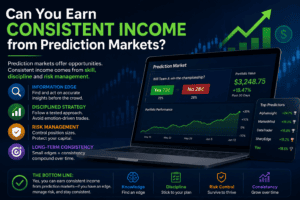
Can You Consistently Make Money on Polymarket?
The honest answer is that some people do.
Many don’t.
Long-term success usually comes from habits rather than clever tricks.
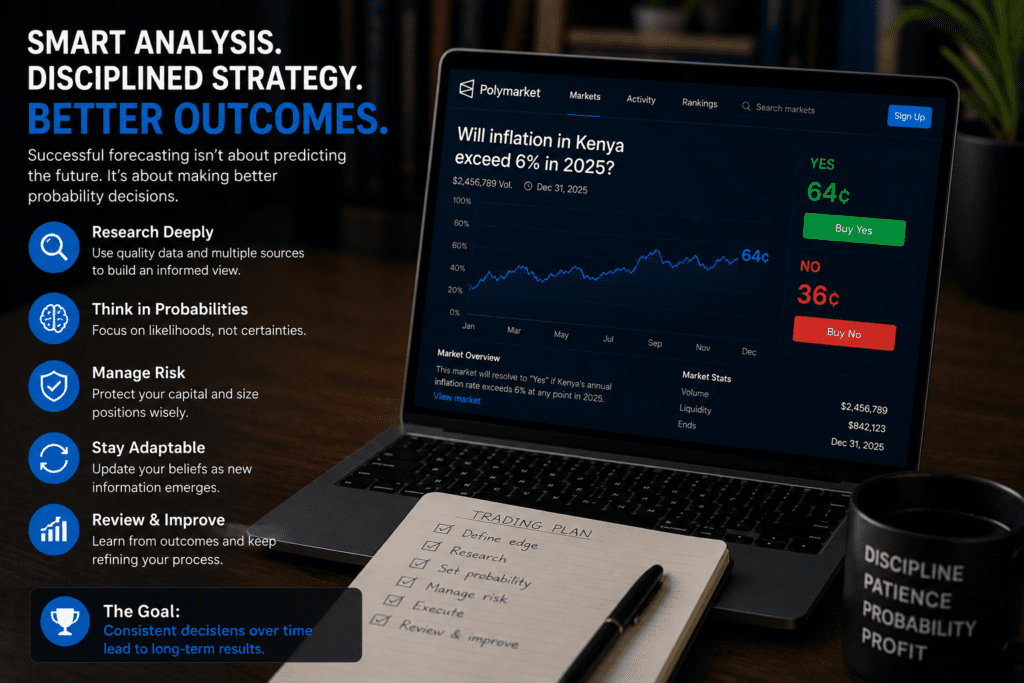
The participants who perform well over time tend to research widely, think probabilistically, manage risk carefully, and change their minds when new evidence appears.
They don’t chase every market.
They don’t assume they’re always right.
And they rarely confuse confidence with accuracy.
Those habits aren’t unique to prediction markets, either. They’re common among good analysts, investors, researchers, and decision-makers in general.
Final Thoughts
Polymarket is often introduced as a place to predict the future, but that’s only partly true.
It’s really a place to estimate uncertainty.
The goal isn’t to know what will happen with complete confidence. Nobody can do that consistently. The goal is to make better probability estimates than the market currently reflects.
Sometimes you’ll be right.
Sometimes you’ll be wrong for good reasons.
Over time, the quality of your thinking matters more than any single prediction.
That’s probably the biggest lesson prediction markets have to offer—and it extends well beyond markets themselves.