
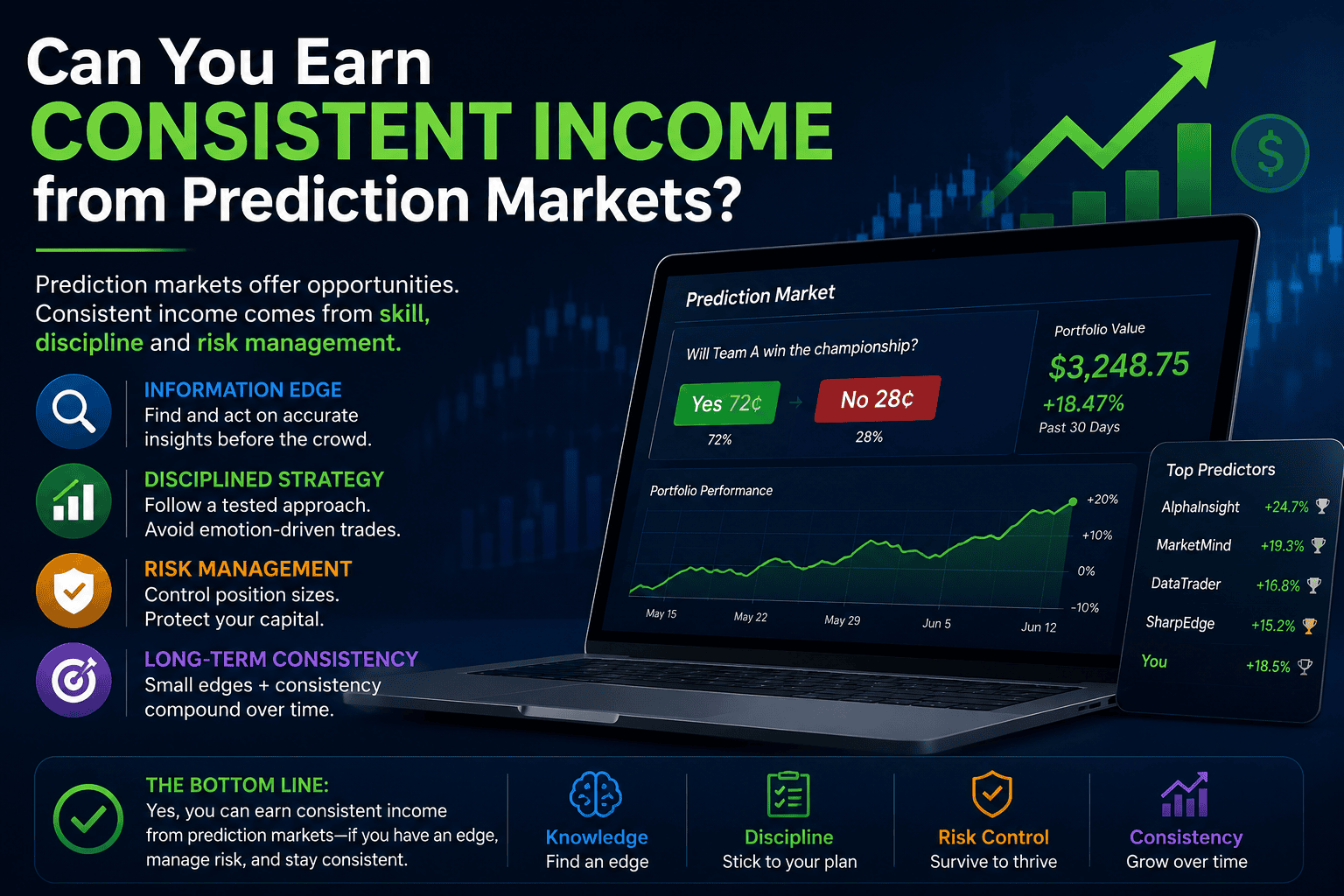
Prediction markets have attracted growing attention over the past few years. Some participants view them as an alternative investment. Others see them as information markets that reward accurate forecasting. And, naturally, there are people who arrive hoping to generate a steady income.
The question is understandable.
Can someone realistically earn consistent income from prediction markets?
The short answer is yes—but only under specific conditions, and certainly not with guaranteed results.
Like financial markets, prediction markets reward participants who can estimate probabilities more accurately than the broader market. That sounds straightforward until you actually try doing it over hundreds of decisions.
Forecasting is difficult.
Staying consistently better than other forecasters is even more difficult.
Table of Contents
Prediction Markets Reward Information, Not Guesswork
Every prediction market reflects competing opinions about the likelihood of future events.
These events might involve:
- Elections
- Economic indicators
- Financial markets
- Sports
- Technology
- Public policy
- Business developments
Participants who identify situations where market prices differ from reasonable probability estimates may find profitable opportunities.
Notice the wording.
The objective isn’t predicting everything correctly.
It’s identifying situations where the market’s implied probability appears inaccurate.
That distinction matters.
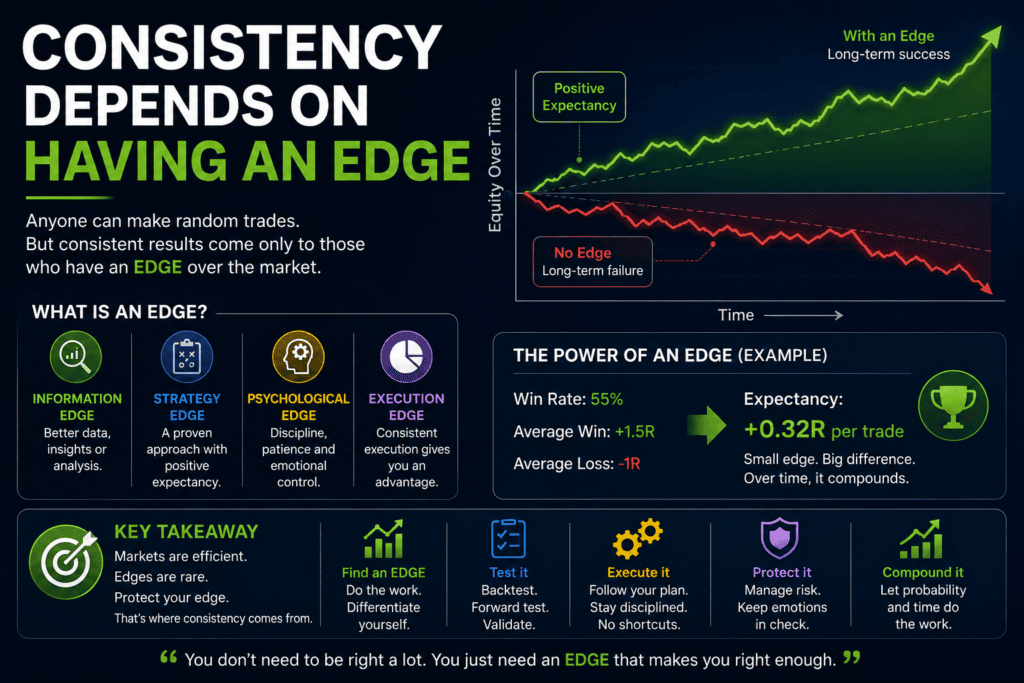
Consistency Depends on Having an Edge
Long-term profitability generally requires an informational or analytical advantage.
That edge might come from:
- Better research
- Statistical analysis
- Domain expertise
- Faster interpretation of new information
- Superior probability estimation
Simply following headlines or public opinion rarely creates a lasting advantage.
Markets already incorporate widely available information surprisingly quickly.
By the time a story becomes common knowledge, prices have often adjusted.
Probability Matters More Than Being Right
One of the more interesting aspects of prediction markets is that success isn’t measured solely by accuracy.
Imagine forecasting an event with a 30% chance of occurring.
If it happens, your forecast wasn’t necessarily wrong.
Likewise, correctly predicting an event that had a 90% probability doesn’t automatically demonstrate exceptional forecasting skill.
Good forecasters focus on calibration.
They aim to assign probabilities that closely match reality over many observations rather than seeking perfect prediction on individual events.
That’s a subtle difference, but an important one.
Risk Management Is Essential
Even skilled forecasters experience losing trades.
Variance is unavoidable.
Effective participants often manage risk by:
- Limiting position sizes
- Avoiding emotional decision-making
- Diversifying across multiple markets
- Preserving capital during uncertain periods
Risk management does not eliminate losses.
Its purpose is ensuring that individual mistakes do not end participation altogether.
Many forecasting strategies fail not because the underlying analysis was poor, but because position sizing was too aggressive.
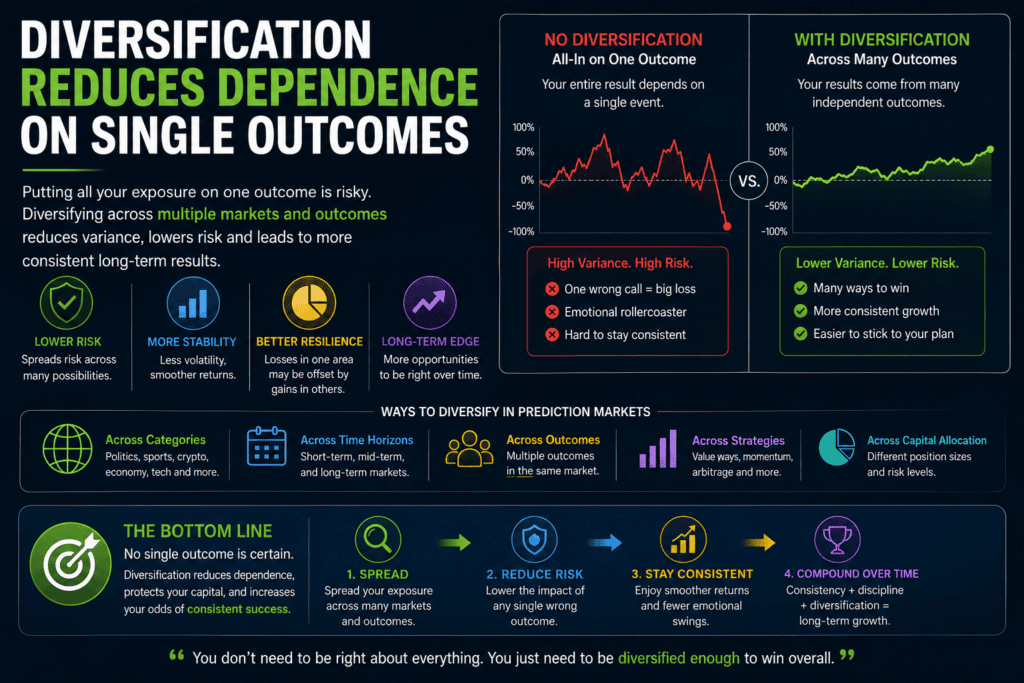
Diversification Reduces Dependence on Single Outcomes
Concentrating all capital on one forecast increases exposure to uncertainty.
Diversification spreads risk across multiple independent markets.
For example, a participant might hold positions involving:
- Politics
- Economics
- Financial markets
- Technology
- Sports
Independent events reduce the impact of any single incorrect forecast.
Diversification cannot guarantee profits.
It can, however, reduce portfolio volatility over time.
Trading Discipline Often Matters More Than Intelligence
Successful forecasting requires more than knowledge.
Behavior frequently determines long-term outcomes.
Common characteristics of disciplined participants include:
- Following predefined rules
- Avoiding impulsive trades
- Accepting uncertainty
- Updating opinions when evidence changes
- Recording previous decisions
Changing your view after receiving better information is not inconsistency.
It’s usually evidence of rational decision-making.
Markets reward adaptation more often than stubbornness.
Emotional Decisions Can Be Costly
Prediction markets involve uncertainty by design.
That uncertainty can encourage emotional reactions after wins or losses.
Common mistakes include:
- Increasing risk after a profitable trade.
- Chasing previous losses.
- Ignoring new evidence.
- Becoming overconfident after short-term success.
- Holding positions simply because of personal beliefs.
These behaviors appear across financial markets as well.
Managing emotions remains one of the more underestimated forecasting skills.
Historical Performance Doesn’t Guarantee Future Results
Some participants achieve impressive long-term records.
Others experience periods of strong performance followed by extended declines.
Forecasting environments evolve.
Market participants change.
Information becomes more widely available.
Strategies that worked several years ago may become less effective as markets become increasingly efficient.
Continuous learning therefore remains important.
Technology Is Improving Market Efficiency
Artificial intelligence, faster information distribution, and increased institutional participation have made many prediction markets more competitive.
As more participants analyze similar information, obvious pricing errors become less common.
That does not eliminate opportunities.
It simply raises the standard required to identify them.
Competitive markets naturally reward better analysis while reducing easy profits.
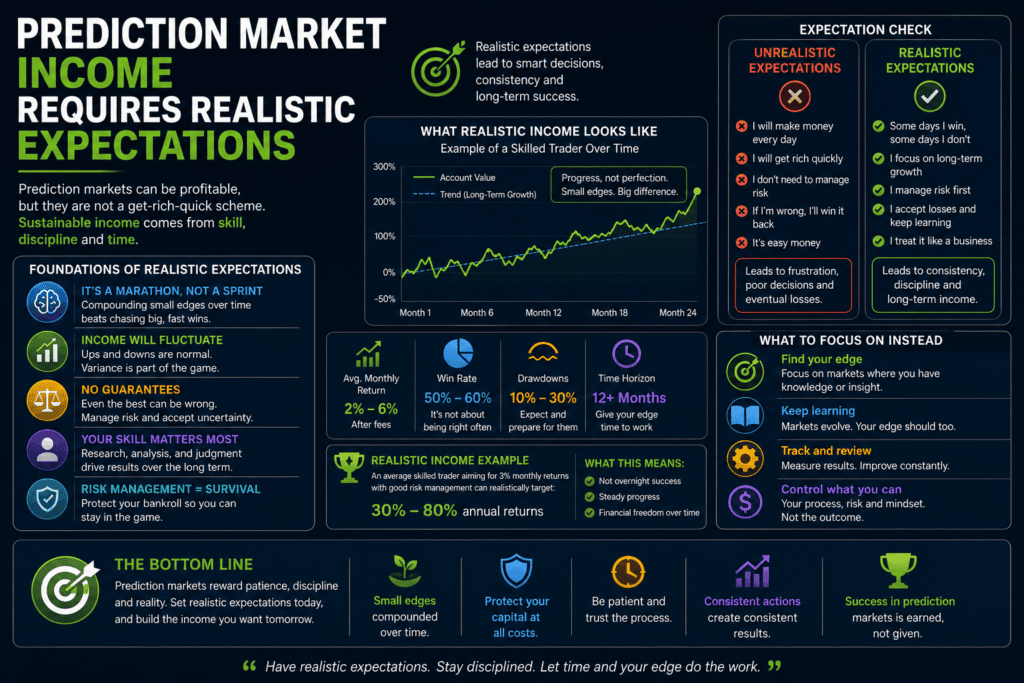
Prediction Market Income Requires Realistic Expectations
The phrase prediction market income sometimes creates unrealistic assumptions.
Prediction markets should not be viewed as guaranteed monthly income.
Instead, they resemble other forms of active investing where outcomes vary over time.
Even profitable participants may experience:
- Losing weeks
- Losing months
- Extended drawdowns
- Unexpected market events
Evaluating performance over long periods generally provides a more accurate picture than focusing on individual outcomes.
Consistency is measured across hundreds of decisions, not five.
Developing a Sustainable Profit Strategy
A sustainable profit strategy often includes several elements working together:
- Evidence-based research
- Probability estimation
- Capital preservation
- Diversification
- Emotional discipline
- Continuous review of forecasting performance
No single strategy guarantees success.
Markets evolve continuously, requiring participants to refine their methods as conditions change.
Adaptability remains an important competitive advantage.
Measuring Forecasting Performance
Professional forecasters typically evaluate themselves using objective metrics rather than memorable wins.
These may include:
- Long-term profitability
- Probability calibration
- Return consistency
- Risk-adjusted performance
- Decision quality
Good decisions occasionally produce poor short-term outcomes.
Poor decisions sometimes generate profits through luck.
Over time, however, disciplined processes tend to reveal themselves more clearly than isolated results.