
If you’ve ever looked at a prediction market and wondered why one outcome is trading at 72% while another sits at 28%, you’re not alone.
At first glance, those numbers seem straightforward. Higher percentage means more likely. Lower percentage means less likely. That’s true, but it’s only part of the story.
What those probabilities really represent is the market’s current expectation based on everything participants collectively know—or think they know. That’s an important distinction. Markets aren’t predicting the future with certainty. They’re estimating it.
Learning how to read those estimates is one of the most useful skills you can develop if you’re interested in forecasting.
It also makes news a little more interesting. Once you start thinking in probabilities, you notice how often people speak with complete certainty about events that are anything but certain.
Table of Contents
What Do Odds Actually Mean?
In prediction markets, odds are usually expressed as probabilities.
Instead of saying a football team has odds of 3-to-1, a market might simply show a 75% chance of winning.
That number isn’t a promise.
It’s the market’s best estimate at that moment.
If a candidate has a 60% chance of winning an election, the market isn’t saying they’ll definitely win. It’s saying that, based on current information, they would be expected to win around six times out of ten if the same situation could somehow be repeated.
Of course, real elections only happen once.
Still, probability gives us a useful way to think about uncertainty.
Understanding Implied Probability
You’ll often hear the phrase implied probability when reading about prediction markets.
It sounds technical, but the idea is fairly simple.
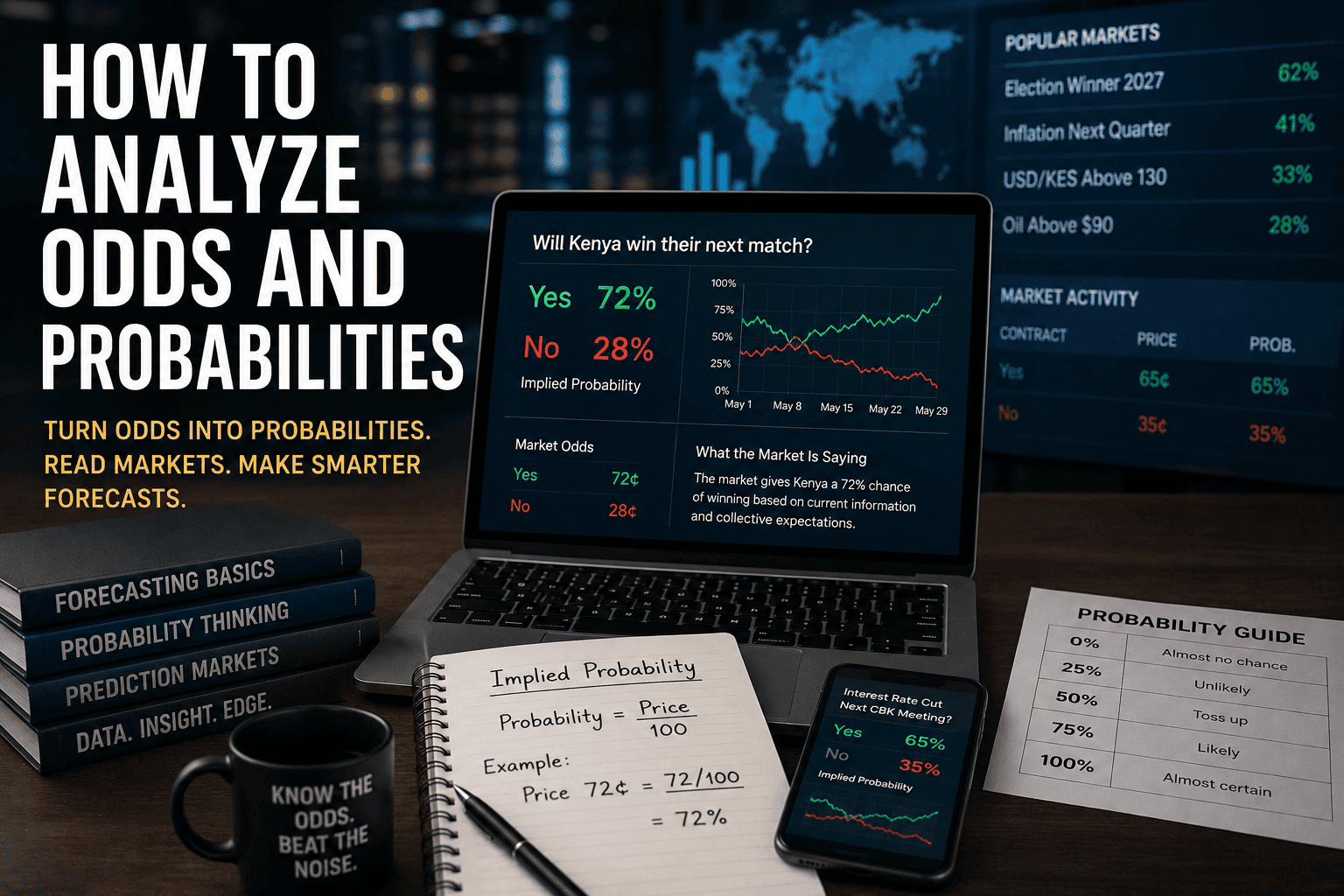
Implied probability is the likelihood suggested by current market prices.
Imagine a prediction market where “Yes” shares for a particular outcome are trading at 68 cents.
That price implies roughly a 68% probability that the event will happen.
The remaining 32% represents the market’s estimate that it won’t.
Nothing magical is happening behind the scenes.
The market price simply reflects what thousands of participants collectively believe after considering news, data, and their own research.
Why Probabilities Change
One thing that surprises beginners is how quickly probabilities move.
Sometimes a market barely changes for days.
Then a single news event pushes probabilities sharply higher or lower.
That’s normal.
Prediction markets constantly adjust as new information becomes available.
A football team loses its top striker to injury.
An economic report comes in stronger than expected.
A political candidate performs well during a televised debate.
Each event changes expectations.
Markets respond by updating probabilities.
You can think of them as living forecasts rather than fixed predictions.
A Football Example
Suppose Kenya is preparing for an important AFCON qualifier.
Before kickoff, the market gives Kenya a 65% chance of winning.
During the match, Kenya scores an early goal.
The probability might climb to 82%.
If the opposing team equalizes late in the game, that probability could fall back toward 50%.
Nothing about the past changed.
Only expectations about the future did.
That’s how probabilities work.
They’re always looking ahead.
A Politics Example
Imagine a presidential election where two candidates begin the campaign with nearly equal support.
Early polling suggests both have a realistic chance of winning.
As the campaign develops, new polls, fundraising reports, economic indicators, endorsements, and debates provide additional information.
Rather than waiting for election day, prediction markets gradually incorporate those developments into updated probabilities.
Someone checking the market each week isn’t seeing certainty.
They’re watching expectations evolve.
An Economics Example
Economic forecasting works in much the same way.
Suppose analysts are discussing whether the Central Bank of Kenya will reduce interest rates at its next meeting.
Before new inflation data is released, markets may assign a 40% probability to a rate cut.
Then inflation comes in lower than expected.
That makes a rate reduction more plausible.
The probability could rise to 65% within hours as traders update their expectations.
The forecast changes because the available evidence changed.
Don’t Confuse Probability With Certainty
This is probably the most common misunderstanding.
A 90% probability does not guarantee success.
It still leaves room for the less likely outcome.
If something has a 10% chance of happening, it will still happen occasionally.
That’s not a failure of forecasting.
That’s exactly how probability works.
People tend to remember surprising outcomes more vividly than expected ones. If an underdog wins an important football match, everyone talks about it.
Nobody is shocked when the favorite wins.
Our memories can make rare events seem more common than they actually are.
Markets don’t have memories.
They simply update probabilities as information changes.
Looking for Value Instead of Certainty
Experienced forecasters rarely ask, “Which outcome is guaranteed?”
Because there usually isn’t one.
Instead, they ask whether the market’s probability seems reasonable.
Imagine you believe an event has a 70% chance of happening after reviewing the available evidence.
If the market currently prices it at only 55%, you may believe the outcome is being underestimated.
That’s sometimes called finding value.
The focus shifts from predicting perfectly to identifying differences between your assessment and the market’s assessment.
That requires research.
And a willingness to admit when the market knows something you don’t.
Why Prediction Markets Are Useful
Prediction markets provide something that ordinary headlines often don’t.
They quantify uncertainty.
A newspaper might report that inflation is expected to fall.
A prediction market can express that expectation as a probability and update it continuously as fresh data becomes available.
That doesn’t eliminate uncertainty.
It simply measures it more clearly.
For journalists, researchers, businesses, and anyone making decisions under uncertainty, that’s valuable information.
Not because markets are always correct.
Because they make expectations visible.
Final Thoughts
Learning how to analyze odds isn’t really about numbers.
It’s about changing how you think.
Instead of asking whether something will happen, you begin asking how likely it is.
That small shift makes a surprisingly big difference.
Prediction markets encourage a mindset built around evidence rather than certainty, probabilities rather than opinions, and continuous learning rather than fixed beliefs.
Nobody predicts the future perfectly.
The goal isn’t perfection.
It’s making better estimates as better information becomes available.