
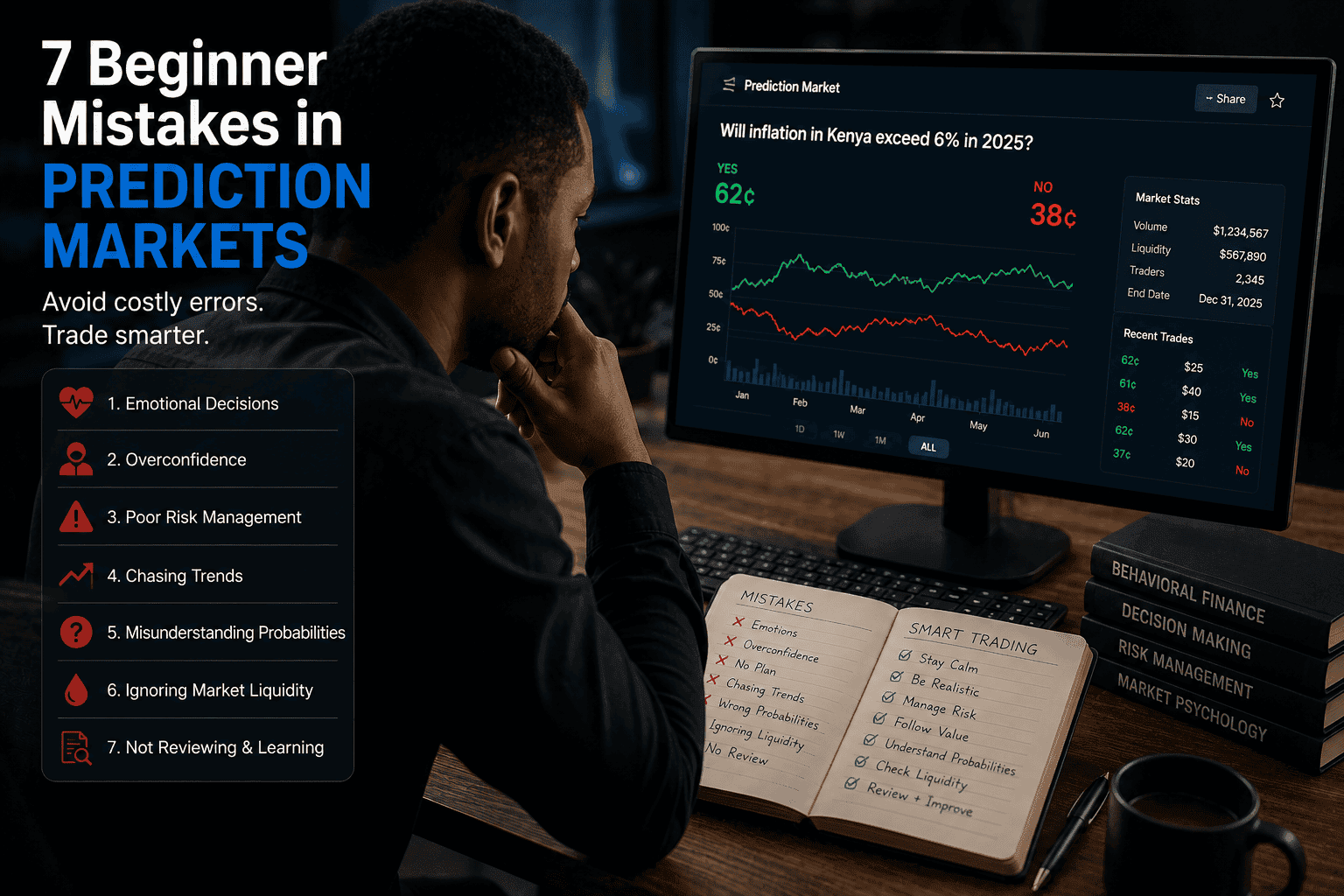
Most people don’t lose money in prediction markets because they lack intelligence.
They lose because they’re human.
That sounds obvious, but it’s easy to forget once real money or even just the desire to be right gets involved. Prediction markets have a way of exposing habits you didn’t know you had. They reward patience, research, and probability-based thinking. Unfortunately, those aren’t always our default settings.
Almost everyone starts with the same assumptions. You think you’ll stay objective. You tell yourself you won’t get emotional. Then one prediction goes against you and suddenly you’re refreshing the market every five minutes. It happens.
The good news is that most beginner mistakes are predictable. Better still, they’re avoidable once you recognize them.
Table of Contents
1. Confusing Confidence With Probability
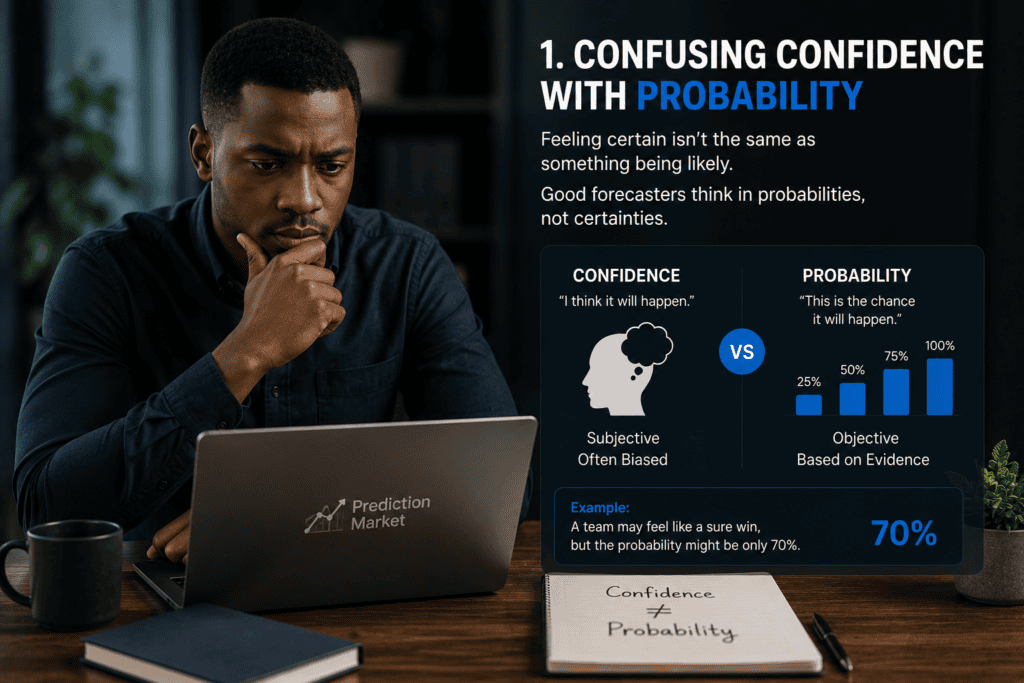
One of the biggest mistakes beginners make is assuming that feeling certain means something is likely to happen.
It doesn’t.
Imagine a football team that looks unbeatable. They’ve won five matches in a row, the media can’t stop talking about them, and everyone around you expects another victory. It’s tempting to think they’re almost guaranteed to win.
But prediction markets don’t deal in certainty. They deal in probabilities.
A team might have a 75% chance of winning. That’s a strong position, but it still means they’ll lose roughly one out of every four matches under similar conditions.
Good forecasters get comfortable with uncertainty. They don’t try to eliminate it.
2. Trading Based on Headlines Instead of Research
News moves markets quickly.
Sometimes too quickly.
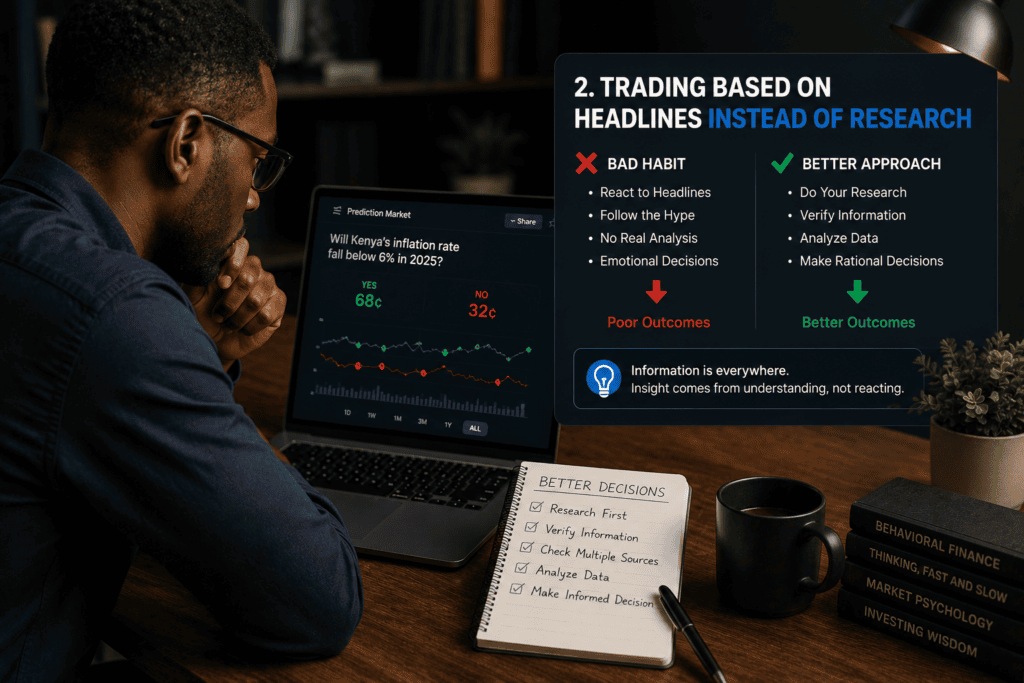
A dramatic headline appears, prices shift within minutes, and beginners rush to follow the movement without asking a simple question.
Has anything actually changed?
There’s a difference between new information and loud information.
A politician making an unexpected statement may dominate social media for a day, but that doesn’t always change the probability of an election outcome. The same applies to sports, economics, and financial markets.
The people who consistently make better forecasts usually spend more time reading beyond the headline than reacting to it.
That sounds less exciting because it is.
It’s also usually more effective.
3. Chasing the Crowd
There’s a certain comfort in agreeing with everyone else.
If thousands of people believe something, surely they can’t all be wrong.
Well… they can.
Prediction markets are valuable because they collect many opinions, but markets can still overreact. Popular narratives sometimes push probabilities higher or lower than the available evidence justifies.
Following the crowd isn’t automatically a mistake.
Following the crowd without understanding why the crowd believes something often is.
It’s worth asking whether you’re making your own assessment or simply borrowing someone else’s confidence.
4. Ignoring Risk Management
This mistake doesn’t usually appear immediately.
It shows up after a few successful predictions.
Someone wins two or three markets, feels they’ve figured everything out, and suddenly starts risking much larger amounts on the next forecast.
Then reality arrives.
Even excellent forecasts fail. An outcome with an 80% chance still doesn’t happen 20% of the time. That’s not bad luck or market manipulation. That’s probability doing exactly what probability does.
Managing risk means accepting that you’ll be wrong sometimes.
The goal isn’t to avoid losses completely. It’s to make sure one bad forecast doesn’t undo months of good decisions.
5. Refusing to Change Your Mind
People become attached to their predictions surprisingly quickly.
Once you’ve publicly argued for something—or committed money to it—it becomes harder to accept evidence pointing in another direction.
Psychologists even have a name for this. Confirmation bias.
We naturally look for information that supports what we already believe while quietly ignoring information that doesn’t.
Good forecasters try to do the opposite.
They’re constantly asking what evidence would prove them wrong.
It’s not always comfortable.
It’s usually worthwhile.
6. Treating Every Market the Same
Not all prediction markets are equally reliable.
Some attract thousands of informed participants and update rapidly as new information becomes available. Others have relatively little activity and may not reflect the full picture.
Beginners often assume every probability should carry the same weight.
That’s rarely true.
A market with broad participation tends to provide stronger signals than one where only a handful of people are actively trading.
Context matters.
It’s one of those phrases that gets repeated often because it keeps turning out to be true.
7. Focusing on Winning Instead of Learning
This may be the mistake that slows improvement the most.
After every prediction, most beginners ask one question.
Did I win?
Experienced forecasters ask something slightly different.
Was my reasoning sound?
Those aren’t always the same thing.
A poorly researched prediction can still succeed because unlikely events happen. Likewise, a careful, evidence-based forecast can fail despite being entirely reasonable.
If you judge every decision solely by the outcome, you’ll struggle to improve.
If you review the quality of your thinking instead, patterns begin to emerge.
That’s where real progress usually happens.
What Successful Forecasters Tend to Do Differently
There’s no secret formula for prediction markets.
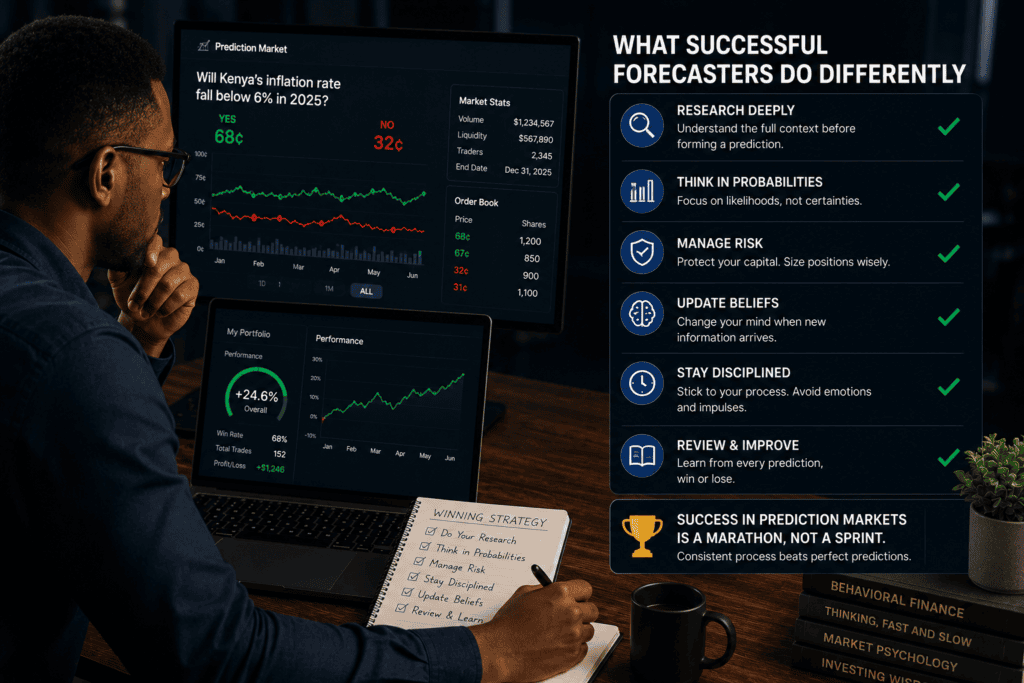
The people who perform well over long periods usually share a few habits rather than a special strategy.
They read widely before making decisions. They think in probabilities instead of certainties. They update their opinions when new evidence appears instead of defending old assumptions. They manage risk carefully and avoid making emotional decisions after a win or a loss.
Perhaps most importantly, they stay curious.
They treat forecasting as a skill that improves through practice rather than a talent people are simply born with.
That mindset changes everything.
Final Thoughts
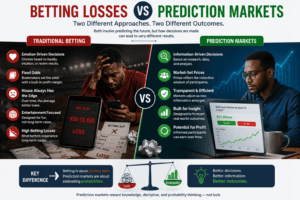
Prediction markets can be a fascinating way to understand uncertainty, but they’re also remarkably good at exposing human psychology.
Most beginner mistakes have very little to do with mathematics or economics.
They’re about impatience.
Overconfidence.
Emotion.
The desire to be right.
Recognizing those tendencies won’t make every forecast accurate. Nothing can do that.
But it will help you make better decisions over time, and that’s ultimately what successful forecasting is about.
Not predicting the future perfectly.
Just understanding it a little more clearly than you did yesterday.