
The 2026 World Cup is still in its early stages, but it already feels a little less predictable than many people expected.
That’s not unusual, exactly. Every tournament produces surprises. We say this every four years and then immediately act shocked when a heavily favored team drops points against an opponent most casual fans haven’t watched all year.
Still, a few results have genuinely shifted the conversation.
Some of the biggest football nations have looked vulnerable. Several underdogs have looked far more comfortable on this stage than expected. And a handful of teams that entered the tournament with modest expectations suddenly find themselves at the center of the story.
Here are the biggest surprises from the group stage so far.
Table of Contents
Mexico’s Strong Start Has Changed Expectations
Mexico entered the tournament carrying the usual pressure that comes with being one of the hosts.
Host nations often start quickly, but there were legitimate questions about whether this Mexican side had enough attacking quality to make a deep run.
So far, they’ve answered some of those concerns.
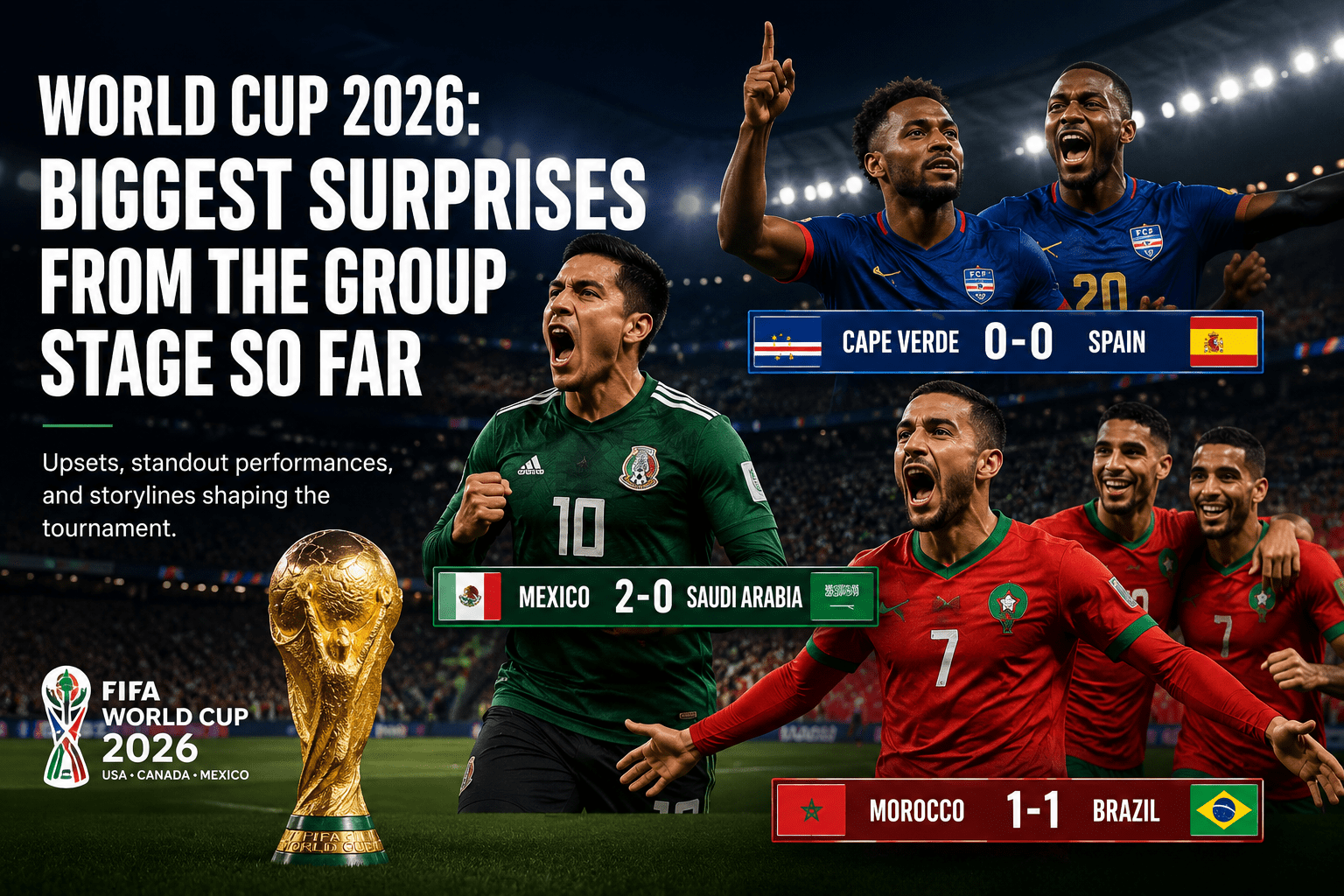
Two victories from their opening matches have secured qualification for the knockout stage and first place in Group A. The performances haven’t always been spectacular, but tournaments aren’t judged on style points.
One thing that’s stood out is Mexico’s defensive discipline.
The attack has looked functional rather than explosive, yet they’ve consistently found ways to win important moments. Sometimes tournament football looks like that. A team can appear slightly uncomfortable and still collect six points.
Those six points tend to matter more.
The atmosphere around Mexico has shifted noticeably over the opening week. Not because they’re suddenly favorites, but because they’re beginning to look more difficult to eliminate than many analysts predicted.
Cape Verde’s Draw Against Spain
This may be the biggest surprise of the tournament so far.
Spain arrived as one of the strongest teams in the competition and among the most widely backed contenders before kickoff.
Cape Verde arrived at its first World Cup.
On paper, the gap looked enormous.
Football rarely follows paper.
The goalless draw immediately became one of the defining stories of the opening round. Spain controlled large stretches of possession, but Cape Verde remained organized, disciplined, and remarkably calm.
What made the result interesting wasn’t just the scoreline.
It was how comfortable Cape Verde looked for long periods.
There was very little panic. Very little desperation. Just a team executing a clear plan against one of the world’s strongest national sides.
For African football, the result felt significant.
Not because one draw changes everything, but because it reinforced a trend we’ve been seeing for years. The gap between traditional powers and emerging nations continues to shrink.
Morocco Continue to Belong Among the Elite
At some point, Morocco stops being an underdog story.
That moment may have already arrived.
Their draw against Brazil attracted attention partly because Brazil remains one of football’s most recognizable powers. But anyone who watched Morocco over the last several years knows this wasn’t some random upset.
Morocco reached the semi-finals in Qatar in 2022. They’ve consistently produced strong performances against elite opposition. Their tactical structure is mature. Their squad has depth.
Still, earning a result against Brazil in a World Cup opener matters.
The match felt less like a giant-killing story and more like confirmation that Morocco now belongs in conversations about serious contenders.
That’s a different category entirely.
And honestly, it’s one many African football supporters have argued for already.
The Expanded Tournament Has Been More Competitive Than Expected
Before the tournament began, there were concerns about the expanded 48-team format.
The criticism was fairly straightforward.
More teams would supposedly lead to more mismatches.
The early evidence hasn’t really supported that argument.
Several established football nations have already dropped points. Others have struggled through difficult matches against teams many observers assumed would simply make up the numbers.
We’ve seen:
- Spain held by Cape Verde
- Brazil forced to settle for a draw
- Belgium dropping points
- Portugal facing tougher resistance than expected
- France pushed hard by Senegal
The tournament feels balanced.
Not perfectly balanced, obviously. Some teams remain significantly stronger than others.
But the overall quality gap appears smaller than many expected.
African Teams Are Shaping the Story
From a Kenyan and broader African perspective, this may be the most interesting development.
African teams aren’t just participating.
They’re influencing the tournament.
Morocco’s result against Brazil grabbed headlines. Cape Verde’s performance against Spain earned widespread attention. Senegal pushed one of Europe’s strongest sides. Egypt and several other African representatives have shown they can compete physically and tactically with almost anyone.
This isn’t entirely new.
African football has been developing steadily for years.
But tournaments create visibility. People notice trends more quickly when they’re happening on the biggest stage.
For younger football fans across the continent, that’s probably meaningful in ways that are difficult to measure.
Why Early Surprises Matter
Group-stage surprises don’t just create headlines.
They change probabilities.
Every unexpected draw or upset reshapes qualification scenarios. Teams that expected comfortable progression suddenly face pressure. Underdogs gain confidence and, occasionally, momentum.
The psychological side of tournaments gets overlooked sometimes.
A favorite that drops points in its opening match often starts playing with urgency.
An underdog that earns a surprise result starts believing it belongs.
That shift can influence the next match and the one after that.
Not always. But often enough.
What To Watch Next
The tournament still has a long way to go.
Historically, many elite teams recover from slow starts and eventually advance deep into the knockout rounds. Spain, Brazil, and other traditional powers remain among the strongest squads in the competition despite their early setbacks.
But the opening matches have delivered an important reminder.
World Cups are difficult to predict because football itself is difficult to predict.
A team’s reputation matters.
Talent matters.
History matters.
Then the match starts and sometimes Cape Verde holds Spain to a draw.
That’s part of why people keep watching.